
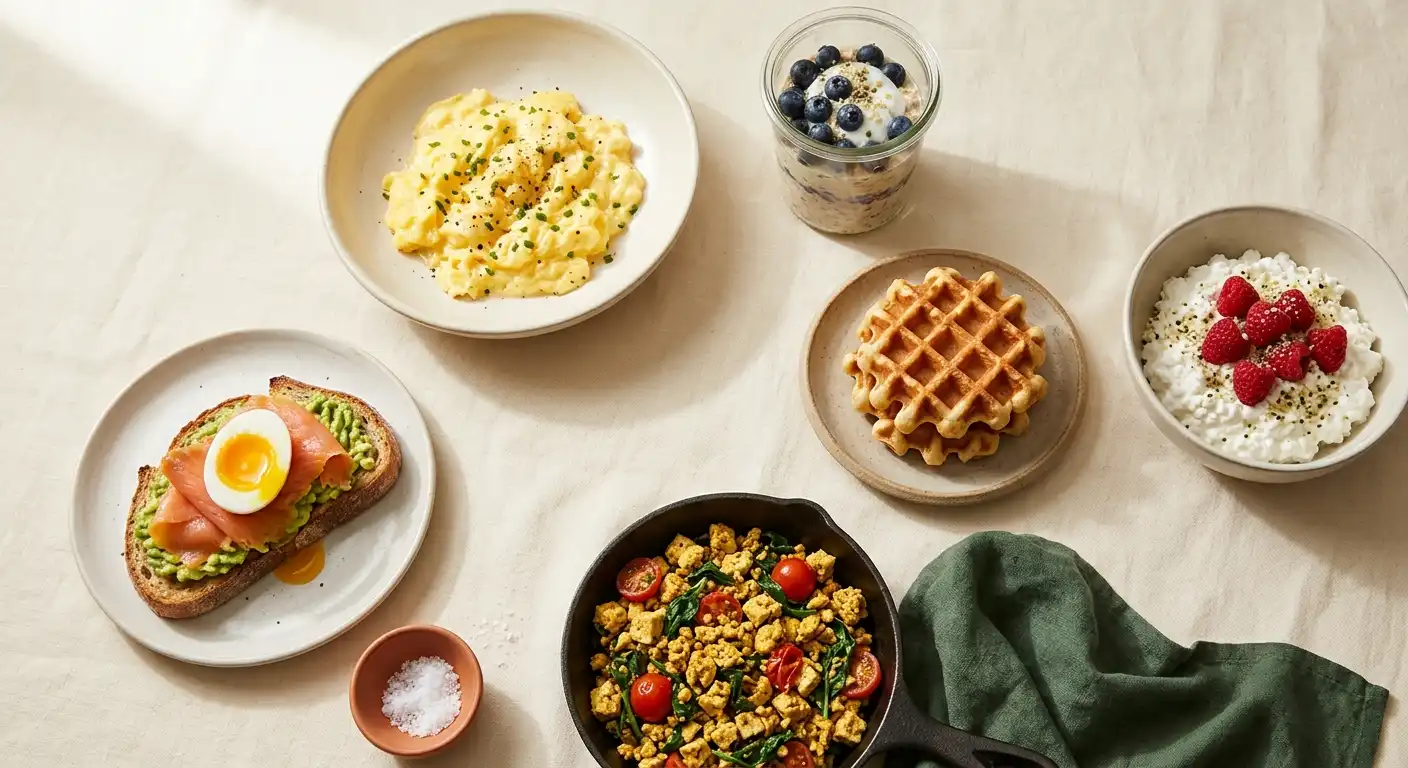
15 recipes with 25g+ protein per serving — no protein powder
Quick answer: A high protein breakfast means roughly 25 to 35 grams of protein in one meal. You can reach that without protein powder by building around eggs, cottage cheese, Greek yogurt, tofu, or lean poultry, then adding a second source like cheese, hemp seeds, or oats. Every recipe below clears 25 grams, and the average across all fifteen is nearly 32 grams per serving.
Most breakfast advice stops at “eat more protein” and never says how much of what. That’s the part that actually matters, because the gap between a bowl of oatmeal and a bowl of oatmeal that keeps you full until lunch is about 20 grams of protein, and you can’t eyeball it.
These fifteen high protein breakfast recipes were built to a rule: no protein powder in any of them. Not because powder is bad, but because it makes the exercise trivial. Anyone can hit 30 grams by adding a scoop. Hitting it with food is harder, more interesting, and it means the recipe still works on a morning when you’ve run out.
Every nutrition figure here is calculated from measured gram weights against USDA data, not estimated. Where a number is unflattering — and four of these recipes carry real sodium — it’s published anyway.
Jump to a section: Compare all 15 · Savory · Sweet · Toast & Griddle · How to hit 25g · Make-ahead · Sodium · FAQs
Compare All 15 at a Glance
| # | Recipe | Protein | Calories | Sodium | Time | Best for |
|---|---|---|---|---|---|---|
| 1 | Savory Tofu Scramble | 39g | 395 | 461mg | 20 min | Vegan, highest plant protein |
| 2 | Savory Oatmeal with Soft Egg | 34g | 562 | 758mg | 20 min | Cold mornings |
| 3 | Greek Yogurt Overnight Oats | 31g | 509 | 135mg | 10 min + overnight | Highest fiber |
| 4 | Scrambled Eggs with Cottage Cheese | 30g | 351 | 772mg | 10 min | Fastest hot breakfast |
| 5 | Black Bean & Egg Quesadilla | 31g | 612 | 1,141mg | 15 min | Eat with one hand |
| 6 | Cottage Cheese Oat Muffins | 27g | 434 | 743mg | 35 min | Freezer batch |
| 7 | Whipped Cottage Cheese Bowl | 29g | 371 | 730mg | 5 min | No cooking at all |
| 8 | Turkey & Egg Breakfast Casserole | 40g | 373 | 572mg | 50 min | Best protein-to-calorie ratio |
| 9 | Egg White & Feta Wrap | 33g | 447 | 1,160mg | 12 min | Lowest fat per gram of protein |
| 10 | Cottage Cheese Egg Bites | 29g | 315 | 788mg | 35 min | Lowest calorie |
| 11 | Cottage Cheese Oat Waffles | 30g | 471 | 829mg | 20 min | Feels least “healthy” |
| 12 | Chia Pudding with Greek Yogurt | 28g | 364 | 135mg | 5 min + overnight | Lowest sodium, high fiber |
| 13 | Greek Yogurt Bowl with Almonds | 33g | 439 | 87mg | 5 min | Lowest sodium overall |
| 14 | Smoked Salmon & Egg Avocado Toast | 31g | 494 | 1,652mg | 15 min | Weekend, highest sodium |
| 15 | Greek Yogurt French Toast | 30g | 557 | 744mg | 20 min | Highest carb, most indulgent |
Figures are per serving, calculated from gram weights against USDA FoodData Central. Your brands and portions will vary — cottage cheese sodium in particular ranges widely between labels.
Savory High Protein Breakfast Ideas
Seven of the fifteen are savory, and there’s a reason they dominate the list. Savory breakfasts reach a high protein number more easily than sweet ones, because eggs, cheese, and poultry are all denser in protein than yogurt or oats, and because you don’t have to work around added sugar.
1. Savory Tofu Scramble with Spinach
39g protein · 395 cal · 20 minutes · vegan
The highest-protein plant-based recipe here, and the one that surprises people. Firm tofu carries 17.3 grams of protein per 100 grams, so a 200-gram portion does most of the work before anything else goes in.
Two things separate a good tofu scramble from a pale, watery one. Press the tofu for at least fifteen minutes under something heavy, or it steams instead of browning. And use kala namak, Indian black salt — its sulfur compounds are what make a tofu scramble taste like eggs rather than like warm tofu. Regular salt won’t do it.
The recipe also finishes with lemon juice off the heat. Without acid, a tofu scramble tastes flat no matter how well you season it.
2. Savory Oatmeal with Soft Egg & Parmesan
34g protein · 562 cal · 20 minutes
Oatmeal doesn’t have to be sweet, and treated as a savory grain it behaves more like risotto or congee. Cook the oats in broth instead of water, stir two beaten eggs in off the heat the way you’d finish a carbonara, and top with a soft-boiled egg and parmesan.
The off-heat technique matters. Add the eggs while the pan is still on the burner and you get scrambled eggs sitting in oatmeal instead of a creamy, glossy bowl.
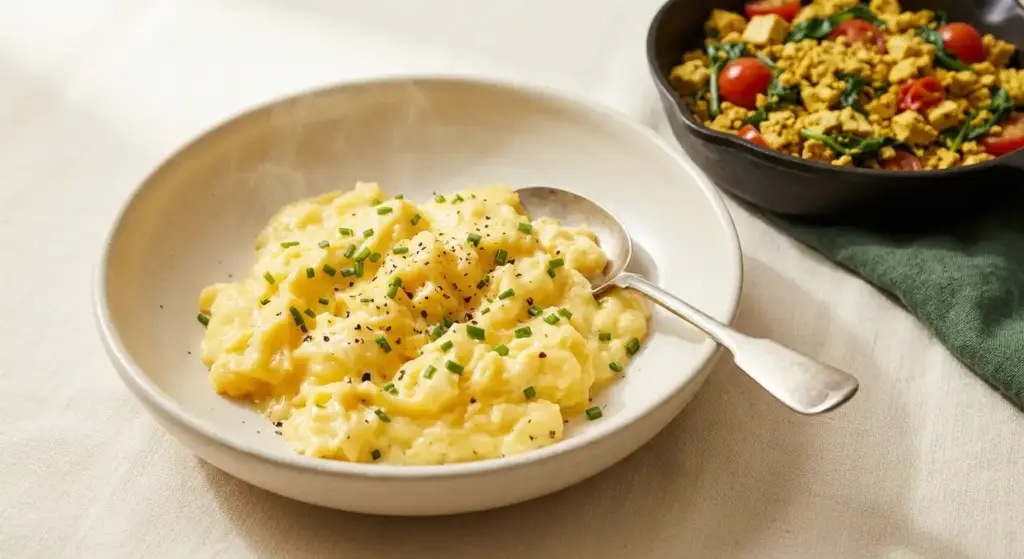
4. Scrambled Eggs with Cottage Cheese
30g protein · 351 cal · 10 minutes
The fastest hot breakfast on this list, and the one worth learning first. Three eggs and 100 grams of cottage cheese give you 30 grams of protein for 351 calories.
The technique detail that changes everything: blend the cottage cheese into the raw eggs, don’t fold it in after cooking. Blended, the curds break down completely and the eggs come out custardy and light. Folded in at the end, you get eggs with lumps of cold cheese in them.
5. Black Bean & Egg Breakfast Quesadilla
31g protein · 612 cal · 15 minutes
Eggs, black beans, and cheddar in a folded tortilla — the one you can eat standing up. Use a 10-inch tortilla rather than an 8-inch; the filling won’t fold otherwise.
Serve the salsa on the side. Inside the quesadilla it releases water into the tortilla within a minute and the whole thing goes limp.
8. Turkey & Egg Breakfast Casserole
40g protein · 373 cal · 50 minutes · serves 6
The best recipe on this list by the number that matters most: 40 grams of protein for 373 calories. Nothing else here comes close on that ratio, and it makes six servings, so one bake covers most of a week.
The single most common failure is a watery casserole, and it has one cause: raw vegetables. Spinach at 100 grams releases a startling amount of liquid into an egg custard. Wilt it, then squeeze it dry in a clean towel. Sauté the peppers first for the same reason.
9. Egg White & Feta Breakfast Wrap
33g protein · 447 cal · 12 minutes
Egg whites are the leanest route to a high protein number — 10.9 grams of protein per 100 grams with almost no fat. Two hundred grams of whites, roughly six eggs’ worth, plus feta and a tortilla lands at 33 grams.
The trade-off is honest: egg whites turn rubbery fast because there’s no yolk fat buffering them. Cook them low and pull them off while they still look slightly underdone. They finish in the residual heat.
10. Cottage Cheese Egg Bites
29g protein · 315 cal · 35 minutes · serves 3
The lowest-calorie recipe here, and the closest thing to the coffee-shop version you can make without a sous vide circulator. Blending cottage cheese with the eggs is what produces that silky, almost custard texture — it isn’t the water bath alone.
They deflate as they cool. That’s normal and unavoidable in a muffin tin: the steam that puffs them escapes. Baking at a lower temperature reduces it.
Sweet High Protein Breakfast Ideas
Sweet breakfasts are the harder problem. Yogurt and cottage cheese sit around 10 to 11 grams of protein per 100 grams, so reaching 25 takes a real portion — and it usually takes a second source alongside it. Every sweet recipe below pairs two.
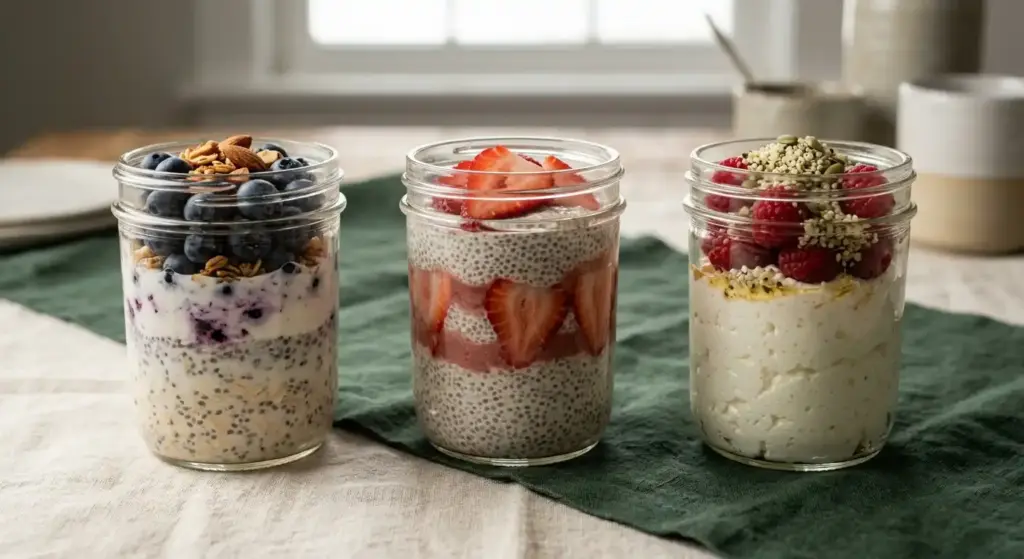
3. Greek Yogurt Overnight Oats with Chia
31g protein · 509 cal · 11g fiber · 10 minutes plus overnight
The highest-fiber recipe on the list, at 11 grams. Greek yogurt does most of the protein work, oats and chia add the rest.
The ratio is where most overnight oats go wrong. Oats absorb roughly twice their weight in liquid, and chia absorbs closer to ten times its own weight. Skimp on liquid and you wake up to a paste. This recipe uses 150 grams of milk on top of the yogurt for exactly that reason.
6. Cottage Cheese & Oat Breakfast Muffins
27g protein · 434 cal · 35 minutes · serves 4
Worth being direct about the portion: a serving is three muffins, not one. A single high protein muffin lands around 9 grams, and any site telling you one muffin is a high protein breakfast is counting on you not checking.
They’re also denser and moister than bakery muffins — closer to baked oatmeal cups. That’s what happens when 500 grams of cottage cheese goes into the batter, and it’s a fair trade for the protein.
7. Whipped Cottage Cheese Bowl with Berries & Hemp
29g protein · 371 cal · 5 minutes
The fastest recipe here, and the one that requires no cooking at all. Whipped cottage cheese is simply cottage cheese blended for about sixty seconds until the curds disappear entirely and it turns into something between crème fraîche and thick yogurt.
That single step is why people who dislike cottage cheese often like this bowl. The objection is almost always texture, not flavor.
Hemp seeds carry it over the line — at 31.6 grams of protein per 100 grams, they’re one of the few seeds dense enough to count.
11. Cottage Cheese Oat Waffles
30g protein · 471 cal · 20 minutes · serves 2
Blender batter: cottage cheese, eggs, and oats ground to flour. No wheat flour, no powder, 30 grams of protein per serving.
The failure mode is a soggy waffle, and it’s a starch problem rather than a cooking problem. Too much cottage cheese relative to oats and there isn’t enough starch to set a crisp shell. This recipe runs 130 grams of oats to 220 grams of cottage cheese for that reason. Let the batter rest five minutes before it hits the iron.
12. Chia Pudding with Greek Yogurt
28g protein · 364 cal · 8g fiber · 5 minutes plus overnight
One of the two lowest-sodium recipes here, at 135mg, and among the easiest to make.
The ratio question comes up constantly, and the honest answer is that chia to liquid runs about 1:10 by weight for a spoonable pudding. This recipe uses 20 grams of chia against 130 grams of milk plus 200 grams of yogurt — the yogurt is thick, so it counts only partly as liquid. More chia than that and you get a solid block.
13. Greek Yogurt Bowl with Almonds & Berries
33g protein · 439 cal · 87mg sodium · 5 minutes
The lowest-sodium recipe on the entire list, by a wide margin, and one of the highest in protein. Two hundred and fifty grams of Greek yogurt is a genuinely large portion — about a cup and a quarter — and that’s what 25 grams of protein from yogurt alone actually looks like.
Almonds and hemp seeds bring it to 33.
Toast & Griddle
14. Smoked Salmon & Egg Avocado Toast
31g protein · 494 cal · 1,652mg sodium · 15 minutes
Avocado toast gets dismissed as a breakfast that leaves you hungry, and on its own that’s fair — avocado carries 2 grams of protein per 100 grams. The fix is two eggs and smoked salmon, which take the same toast from about 8 grams of protein to 31.
The sodium is the highest on this list and it deserves the flag. Cold-smoked salmon runs about 1,880mg per 100 grams, and 60 grams of it accounts for roughly two-thirds of the total. See the sodium section below.
15. Greek Yogurt French Toast
30g protein · 557 cal · 20 minutes
The most indulgent recipe here and still 30 grams of protein, because Greek yogurt goes into the custard alongside the eggs.
Two things determine whether French toast is good or soggy in the middle. Use stale bread — fresh bread is already saturated with its own moisture and can’t take up custard. And keep the custard proportionate: this recipe uses 190 grams of custard for 105 grams of bread. Any more and half of it stays in the bowl, which also means the nutrition numbers on most French toast recipes describe food you didn’t actually eat.
How to Hit 25g of Protein Without Protein Powder
This is the part almost nobody publishes, because the honest numbers aren’t flattering to a lot of breakfast advice.
Here’s what 25 grams of protein actually looks like from a single source:
| Source | Amount needed for 25g | Calories at that amount |
|---|---|---|
| Turkey breast, cooked | 83g | 122 |
| Parmesan | 70g | 274 |
| Gruyère | 84g | 347 |
| Hemp seeds, hulled | 79g | 437 |
| Firm tofu | 145g | 209 |
| Cheddar | 109g | 440 |
| Smoked salmon | 137g | 160 |
| Whole eggs | 198g (4 large) | 283 |
| Cottage cheese, 4% | 225g | 221 |
| Greek yogurt, 2% | 251g | 183 |
| Egg whites | 229g (~7 whites) | 119 |
| Almonds | 118g | 683 |
| Rolled oats, dry | 189g | 716 |
Three things fall out of that table.
Poultry, cheese, and seeds are efficient but come with a catch. Turkey is unbeatable per calorie, but it isn’t a normal breakfast in most homes. Parmesan and gruyère are dense but you’re not eating 70 grams of parmesan on a Tuesday. Hemp seeds work but cost 437 calories.
Dairy and eggs are the realistic backbone, which is why they appear in most of these recipes. A 225-gram serving of cottage cheese or a 250-gram serving of Greek yogurt is a big portion but not an absurd one.
Nuts and grains cannot carry a breakfast on their own. Getting 25 grams from oats means eating 189 grams dry — over 700 calories of oatmeal. From almonds, 683 calories. This is the single most common mistake in high protein breakfast planning: treating oats or nut butter as a protein source rather than as a support.
The practical rule this whole collection is built on: one substantial anchor plus one supporting source. Eggs plus cottage cheese. Yogurt plus hemp seeds. Tofu plus nutritional yeast. Neither one gets there alone; together they clear 25 comfortably.
High Protein Breakfast Meal Prep
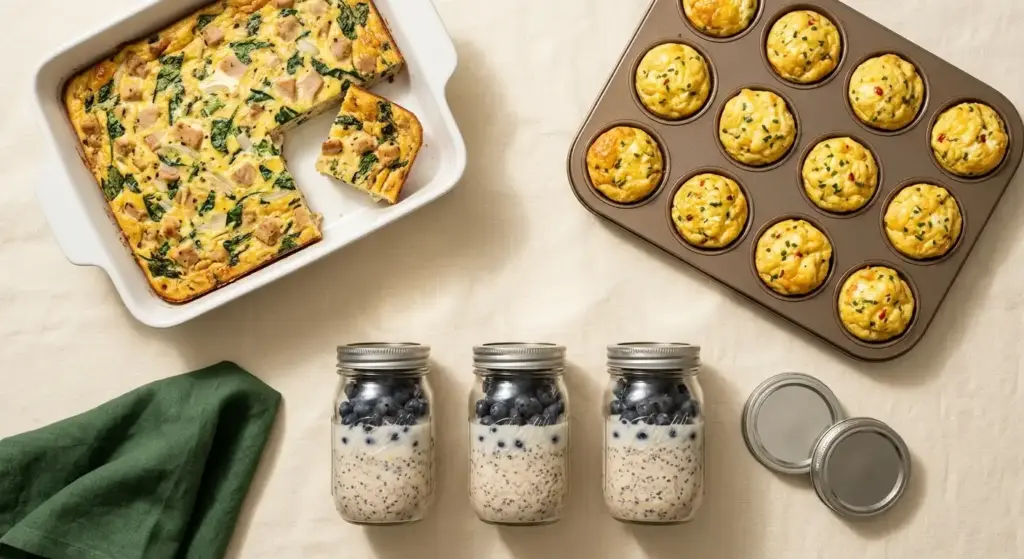
Five of these are built to be made in advance:
- Turkey & Egg Casserole — six servings, keeps 4 days refrigerated. The best return on a single cooking session here.
- Cottage Cheese Egg Bites — twelve bites, three servings, freeze well. Reheat from frozen rather than thawing.
- Cottage Cheese Oat Muffins — twelve muffins, four servings, the most freezer-friendly of the batch.
- Overnight Oats — assemble three jars at once, keeps 3 days. Beyond that the oats go slack.
- Chia Pudding — keeps 4 days and arguably improves on day two as the chia finishes hydrating.
Two rules that apply across all of them. Cool anything baked completely before it goes in a container, or condensation collects on the lid and drips back down. And add fruit or anything crunchy at serving time, not during prep — berries release water into yogurt within a day, and nuts go soft.
A Note on Sodium
Four of these fifteen recipes carry more than 800mg of sodium per serving, and one carries 1,652mg. Those figures are published rather than buried because they’re real, and because most recipe sites simply don’t show the number.
| Recipe | Sodium | Main contributor |
|---|---|---|
| Smoked Salmon Avocado Toast | 1,652mg | Smoked salmon (~1,880mg per 100g) |
| Egg White & Feta Wrap | 1,160mg | Feta, tortilla, and carton egg whites |
| Black Bean Quesadilla | 1,141mg | Tortilla, cheddar, canned beans |
| Cottage Cheese Waffles | 829mg | Cottage cheese and baking powder |
For context, general dietary guidance in the US puts the daily upper limit around 2,300mg for most adults. A breakfast at 1,652mg uses roughly two-thirds of that in one meal.
None of this makes these recipes off-limits. It means they’re worth knowing about, and worth balancing across the rest of the day rather than pairing with a salty lunch. If sodium is something you’re actively managing, the Greek Yogurt Bowl at 87mg and the Chia Pudding at 135mg are the two to reach for.
Three practical reductions: rinse canned beans thoroughly, buy cottage cheese by comparing labels rather than assuming they’re equivalent, and check whether your carton egg whites have added salt — many do.
Anyone managing blood pressure or a specific health condition should take individual advice from a qualified professional.
High Protein Breakfast FAQs
What counts as a high protein breakfast?
Roughly 25 to 35 grams of protein in one meal is a sensible target for most adults. That’s the range where a breakfast tends to keep people satisfied for several hours rather than one. Below about 20 grams, a breakfast behaves more like a snack regardless of how large it looks. Individual needs vary with body size and activity level, so treat it as a guideline rather than a rule.
Can you get 30 grams of protein at breakfast without protein powder?
Yes, and every recipe in this collection does it. The approach that works is pairing two sources rather than relying on one: three eggs plus 100 grams of cottage cheese reaches 30 grams, as does 250 grams of Greek yogurt with almonds and hemp seeds. Reaching 30 grams from a single food means a very large portion — 300 grams of Greek yogurt, or four and a half eggs.
What is the highest protein breakfast food?
Per calorie, cooked poultry is the most efficient: turkey breast delivers 30 grams of protein per 100 grams for 147 calories. Among more typical breakfast foods, egg whites are the leanest at 10.9 grams per 100 grams with almost no fat, and firm tofu is the densest plant source at 17.3 grams per 100 grams. Hard cheeses like parmesan are dense in protein but come with substantial fat and sodium.
How much protein should you eat at breakfast for weight loss?
Around 25 to 35 grams is the usual recommendation, mainly because protein tends to be more satiating than carbohydrate or fat at the same calorie level, which can make a calorie deficit easier to maintain. But a high protein breakfast isn’t automatically low in calories — the recipes here range from 315 to 612 per serving. The useful habit is knowing roughly what’s in the bowl rather than assuming that “high protein” means “light.”
What is the quickest high protein breakfast?
The whipped cottage cheese bowl and the Greek yogurt bowl both take five minutes and need no cooking. For a hot breakfast, scrambled eggs with cottage cheese takes ten minutes and lands at 30 grams of protein.
Is a savory breakfast better than a sweet one for protein?
Generally yes, and the numbers show it. Eggs, cheese, and poultry are denser in protein than yogurt or oats, so savory recipes reach a high number with smaller portions. The seven savory recipes here average slightly higher protein than the six sweet ones, and they do it with less added sugar. That said, the highest-protein recipes in both categories land within a few grams of each other.
Which One Should You Make First?
If you want the best return on a single cooking session, make the Turkey & Egg Casserole. Forty grams of protein for 373 calories, six servings, and it reheats well.
If you have ten minutes on a weekday morning, scrambled eggs with cottage cheese is the one — and the blended-cottage-cheese technique is worth learning on its own.
If you’re skeptical that a high protein breakfast can taste like a treat, start with the cottage cheese oat waffles. No flour, no powder, 30 grams of protein, and they taste like waffles.
And if you’re new to building breakfasts this way, the whipped cottage cheese bowl demonstrates the whole principle in five minutes: two protein sources working together, no cooking, no powder.
Made a version that worked well? Leave a rating and a comment — the best variations usually come from readers.