
Quick answer: This Greek yogurt breakfast bowl has 33 grams of protein and 439 calories per serving, and takes about 5 minutes with no cooking. The yogurt carries 25 of those grams on its own; seeds and nuts add most of the rest. Serves 1. At 87 mg of sodium it’s the lowest in the collection by a wide margin.
A Greek yogurt bowl is the easiest high protein breakfast there is, and the one most likely to be built badly. Not because it’s hard, but because the toppings that look like they’re doing something usually aren’t.
Twenty grams of honey adds 61 calories and 0.06 grams of protein. Twenty grams of hemp seeds adds 111 calories and 6.32 grams. Both look like one spoonful.
This recipe is built on that arithmetic, and the toppings table below is the part worth keeping.
Why This Bowl Has 33 Grams of Protein
| Source | Per serving |
|---|---|
| Greek yogurt, 2% (250 g) | 24.9 g |
| Almonds (20 g) | 4.2 g |
| Hemp seeds (10 g) | 3.2 g |
| Berries and honey (110 g) | 0.9 g |
| Total | 33.2 g |
The yogurt does 75% of the work. Two hundred and fifty grams is a large portion — about a cup and a quarter — and it’s what 25 grams of protein from yogurt alone actually looks like. Anyone telling you a single 150-gram container is a high protein breakfast is counting on you not checking.
The fruit contributes 0.9 grams between all of it. That isn’t an argument against fruit — raspberries carry real fiber and the berries are what make the bowl worth eating — but it is an argument against expecting protein from them.
What 20 g of Each Topping Actually Adds
This is the table that decides whether a yogurt bowl reaches 33 grams or stalls at 25. All figures are per 20 grams: roughly two tablespoons of seeds, a small handful of nuts, or a heaped spoonful of fruit.
| Topping | Protein | Calories | Fiber |
|---|---|---|---|
| Hemp seeds | 6.3 g | 111 | 0.8 g |
| Almonds | 4.2 g | 116 | 2.5 g |
| Chia seeds | 3.3 g | 97 | 6.9 g |
| Rolled oats | 2.6 g | 76 | 2.0 g |
| Raspberries | 0.2 g | 10 | 1.3 g |
| Banana | 0.2 g | 18 | 0.5 g |
| Blueberries | 0.1 g | 11 | 0.5 g |
| Strawberries | 0.1 g | 6 | 0.4 g |
| Honey | 0.06 g | 61 | 0 |
| Maple syrup | 0.01 g | 52 | 0 |
Hemp seeds are the most efficient topping by a clear margin — 6.3 grams of protein for the same calories as almonds. If you add one thing to a yogurt bowl, add these.
Chia is the fiber play, at 6.9 grams per 20 grams. Nothing else on the list is close.
Honey and syrup are pure calories. Sixty-one calories for 0.06 grams of protein is the worst ratio here. This recipe includes 10 grams because it genuinely improves the bowl, but it’s the first thing to cut if calories matter.
What You Need
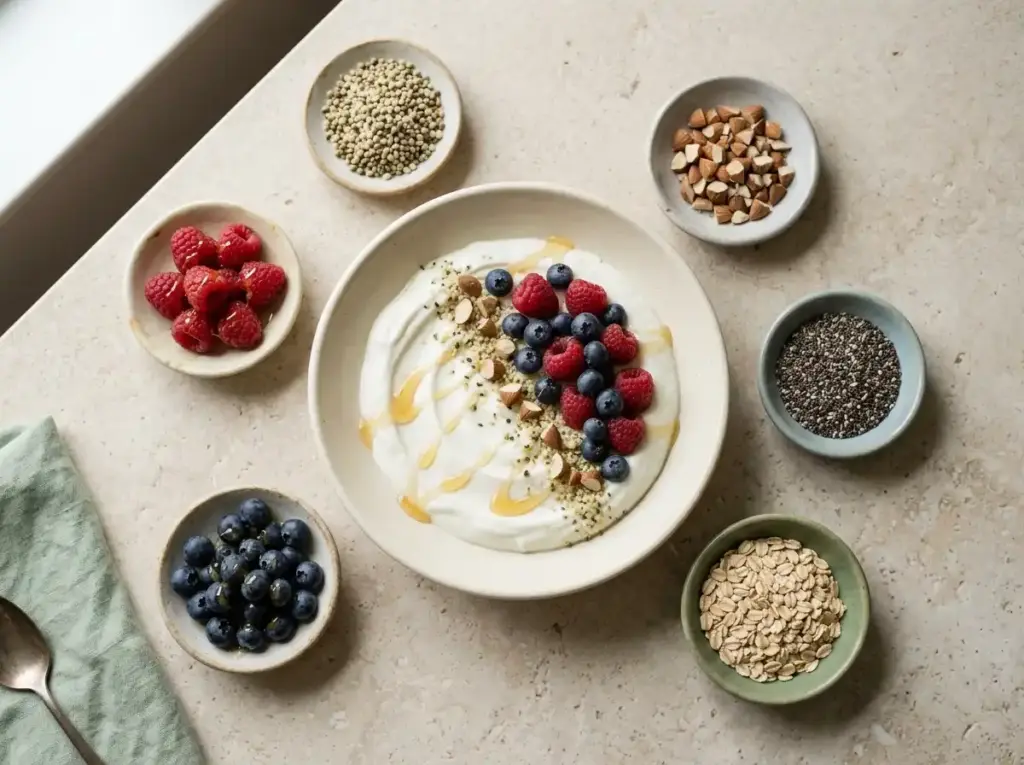
- 1 cup + 2 tablespoons plain Greek yogurt, 2% (250 g)
- 2½ tablespoons almonds, roughly chopped (20 g)
- 1 tablespoon hemp seeds, hulled (10 g)
- ½ cup blueberries (60 g)
- ⅓ cup raspberries (40 g)
- 1½ teaspoons honey (10 g)
Notes on the ones that matter:
Plain yogurt, not vanilla or fruit-flavoured. Flavoured Greek yogurt typically carries 10 to 15 grams of added sugar per serving and slightly less protein, because the purée displaces yogurt.
2% rather than nonfat. Nonfat carries marginally more protein per 100 grams, but 2% is noticeably less sharp and more satisfying, and the difference across a 250-gram serving is under a gram.
Chop the almonds. Whole almonds sit on top and get eaten separately. Chopped, they distribute and every spoonful has some.
How to Make It
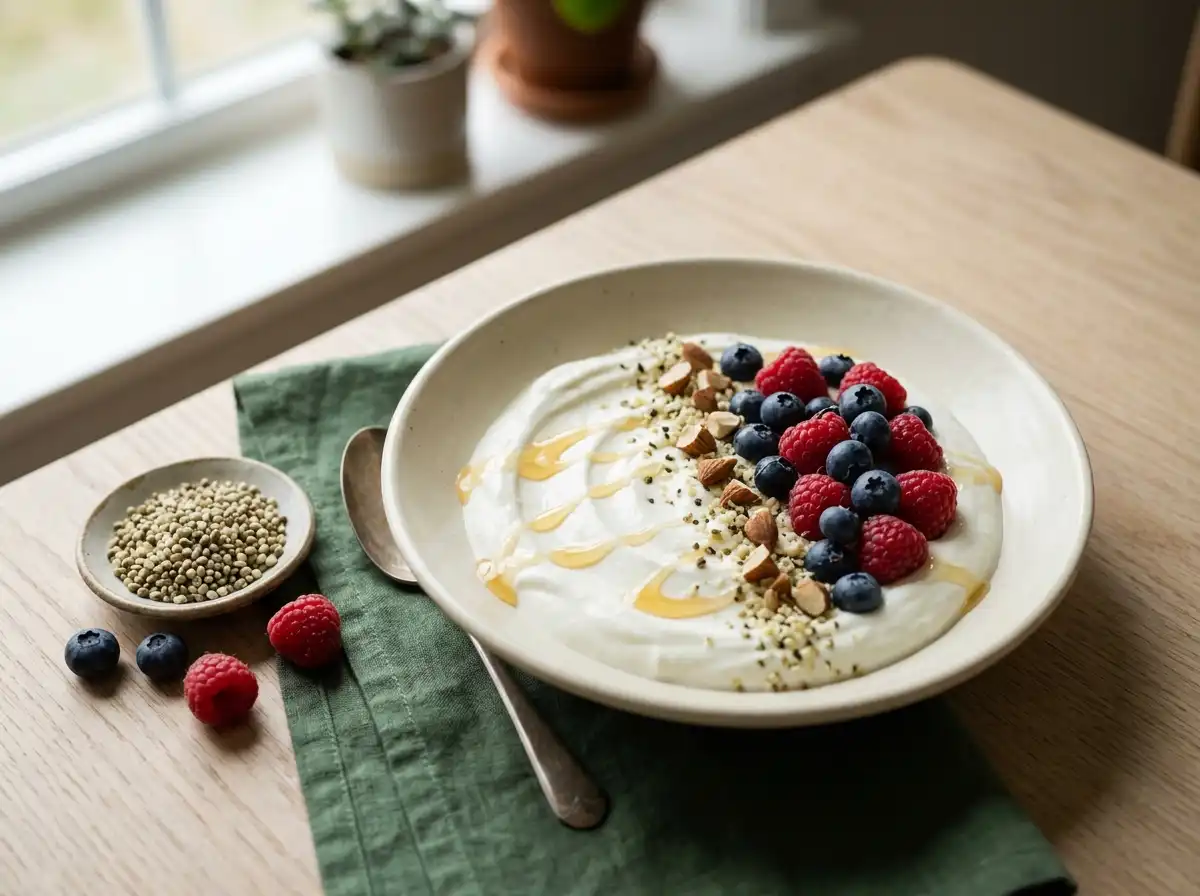
- Spoon the yogurt into a wide shallow bowl rather than a deep one. It sounds cosmetic, but a wide bowl means every spoonful picks up toppings instead of hitting plain yogurt for the last third.
- Stir the honey through before the toppings go on.
- Scatter the berries, then the almonds and hemp seeds last, so they stay on the surface and keep their crunch.
Five minutes, no cooking.
Tips
Stir the honey in, don’t drizzle it. This is the difference between a bowl that tastes sweet throughout and one where the first two bites are sweet and the rest is plain.
Toast the almonds if you have four spare minutes. A dry pan over medium heat, three to four minutes, shaking often. It changes the bowl more than any other single step here.
Add nuts and seeds last. Buried in the yogurt they soften within minutes. On top they stay crisp until you finish.
Wide bowl, not deep. Worth repeating because it genuinely affects how the bowl eats.
Which Greek Yogurt to Buy
The label is worth two minutes, because the range between products is wider than most people assume.
Compare protein per 100 grams, not per container. Container sizes vary from 150 g to 227 g, which makes the front-of-pack number useless for comparison. Plain Greek yogurt should land around 9 to 11 grams per 100 grams.
Watch for “Greek-style”. In some markets this describes a thickened regular yogurt rather than a strained one. Straining is where the protein concentration comes from — thickeners don’t do the same thing. The ingredient list tells you: strained yogurt lists milk and cultures, thickened yogurt lists starch, pectin or milk protein concentrate.
Skyr is a reasonable alternative. It’s strained further than Greek yogurt and typically lands slightly higher in protein with less fat. Check the label rather than assuming.
Substitutions
Every figure below is per serving, calculated from the same USDA data as the main recipe.
| Swap | Protein | Calories | Sodium | Notes |
|---|---|---|---|---|
| Almonds → hemp seeds, same weight | +2.1 g | −5 | 0 | The most efficient swap available. Softer texture. |
| Add 20 g rolled oats | +2.6 g | +76 | 0 | Turns it into more of a meal. Let it sit 10 minutes to soften. |
| Greek yogurt → blended cottage cheese | +2.9 g | +62 | +825 mg | More protein, but the sodium jump is large. See note. |
| Blueberries → raspberries | +0.3 g | −3 | 0 | Also raises fiber from 7.0 g to 8.2 g |
| Skip the honey | 0 g | −30 | 0 | The berries carry more sweetness than you’d expect. |
On the cottage cheese swap: it adds 2.9 grams of protein but takes the bowl from 87 mg of sodium to over 900 mg. That’s a real trade, not a free upgrade, and it’s why this recipe uses yogurt. If you want the cottage cheese version, the whipped cottage cheese bowl is built for it.
Storage
This one isn’t really a make-ahead recipe, and it’s worth being direct about that.
Assembled, it holds about 4 hours before the berries release water and the nuts soften. Edible after that, not good.
What does work: portion the yogurt into jars for up to 5 days, and keep a small container of pre-mixed nuts and seeds separately. Assembly takes thirty seconds each morning and everything stays as it should.
Don’t freeze it. Greek yogurt separates on thawing.
If you want a genuinely make-ahead version of this idea, chia pudding keeps four days and improves on day two.

Greek Yogurt Breakfast Bowl
Ingredients
Method
- Spoon the Greek yogurt into a wide shallow bowl.
- Stir the honey through the yogurt before adding any toppings.
- Scatter over the blueberries and raspberries.
- Add the chopped almonds and hemp seeds last so they stay crisp.
Notes
- Stirring the honey through, rather than drizzling it, distributes the sweetness evenly.
- Toasting the almonds for 3 to 4 minutes in a dry pan improves the bowl more than any other step.
- Best assembled fresh. For meal prep, portion the yogurt into jars and keep nuts and seeds separate.
Nutrition
Per serving (recipe makes 1):
| Calories | 439 |
| Protein | 33 g |
| Carbohydrates | 37 g |
| Fiber | 7 g |
| Fat | 20 g |
| Sodium | 87 mg |
These figures are calculated ingredient by ingredient from a USDA-sourced nutrition database and divided by the serving count. They’re calculated values rather than laboratory-tested ones, and they’ll shift with your brands. Carbohydrates include fiber, following the US convention, so net carbs are about 30 grams per serving.
At 87 mg, this is the lowest-sodium recipe in the collection — 85 of those milligrams occur naturally in the yogurt rather than being added. For context, the same collection includes a smoked salmon toast at 1,652 mg. The range across fifteen breakfasts is that wide, which is the main argument for publishing the number at all.
Frequently Asked Questions
How much protein is in a Greek yogurt bowl?
It depends almost entirely on the yogurt portion. Plain Greek yogurt carries around 10 grams of protein per 100 grams, so a 250-gram serving contributes about 25 grams. This bowl reaches 33.2 grams with almonds and hemp seeds added. A smaller 150-gram container with fruit and granola typically lands between 15 and 18 grams.
What toppings go on a Greek yogurt bowl?
For protein: hemp seeds are the most efficient at 6.3 grams per 20 grams, followed by almonds at 4.2 and chia at 3.3. For fiber: chia at 6.9 grams per 20 grams, then almonds and raspberries. For flavour: berries, cinnamon, a small amount of honey. Fruit and honey add very little protein — all the berries in this recipe together contribute 0.9 grams.
Is a Greek yogurt bowl a complete breakfast?
At this size, yes. It carries 33 grams of protein, 7 grams of fiber and 439 calories, which is a full meal by any reasonable measure. A smaller version — a single 150-gram container with fruit — lands closer to 15 grams of protein and behaves more like a snack.
Which Greek yogurt has the most protein?
Compare labels by protein per 100 grams rather than per container, since container sizes vary widely. Plain Greek yogurt generally falls between 9 and 11 grams per 100 grams; nonfat versions run marginally higher than 2%. Skyr is strained further and often lands slightly above Greek yogurt. Avoid flavoured versions, which add sugar and dilute the yogurt itself.
Can you meal prep Greek yogurt bowls?
Partly. Assembled bowls hold about 4 hours before the berries release water and the nuts go soft. The practical approach is portioning yogurt into jars for up to 5 days and keeping a separate container of pre-mixed nuts and seeds, then combining each morning. Don’t freeze — Greek yogurt separates on thawing.
Made this? Leave a rating and tell me your topping combination — the table above covers the common ones, but readers always find better.