
Quick answer: These mason jar salads have 46 grams of protein and 445 calories per jar, and the recipe makes five jars — a full working week. The dressing goes in the bottom, the spinach goes on top, and nothing touches anything it would ruin. They keep for up to 4 days in the fridge. You’ll need quart-size jars, not the smaller ones.
Most mason jar salads are a nice idea that falls apart by Wednesday. Either the greens are sitting in dressing by day two, or the whole jar amounts to lettuce and a few strips of chicken and you’re hungry at three.
This one is built to fix both problems. The layering keeps the wet ingredients away from the leaves, and each jar carries 120 grams of cooked chicken plus quinoa and feta — which is why the protein lands at 46 grams rather than the 20-something that a jar salad usually manages.
It’s the most complete meal in the high protein salad collection, and the one that holds up best across a working week.
Why This Jar Salad Has 46 Grams of Protein
| Source | Per jar |
|---|---|
| Cooked chicken breast (120 g) | 37.2 g |
| Quinoa (80 g cooked) | 3.5 g |
| Feta (20 g) | 2.8 g |
| Spinach (40 g) | 1.2 g |
| Everything else | 0.8 g |
| Total | 45.5 g |
The chicken does about 80% of the work. Quinoa is often described as a protein source, and it is a complete one, but at a realistic portion it contributes three and a half grams — useful, not decisive. If you cut the chicken to save money or calories, the number falls fast and nothing else in the jar picks up the slack.
You’ll Need Quart Jars, Not Pint Jars
This matters more than it sounds, and it’s the most common reason a jar salad recipe fails at the assembly stage.
Each jar holds 365 grams of food. That needs a quart-size (32 oz / 950 ml) wide-mouth jar. The 16 oz jars most jar salad recipes use are built for lighter salads with a tablespoon or two of dressing — this one has quinoa and chicken in it, and it won’t fit.
Wide-mouth matters too. You’re layering by hand and eventually tipping everything out. A narrow neck makes both jobs unpleasant.
What You Need
Makes 5 jars.
For the lemon dressing
- ¼ cup fresh lemon juice (60 g), about 2 lemons
- 3 tablespoons extra-virgin olive oil (40 g)
- ½ teaspoon table salt (3 g)
- 1 teaspoon freshly ground black pepper (2 g)
For the jars
- 4 cups diced cooked chicken breast (600 g / 21 oz)
- 2¼ cups cooked quinoa (400 g), from about ¾ cup dry
- 1½ cups diced cucumber (200 g), about 1 medium
- 1⅓ cups halved cherry tomatoes (200 g)
- ⅔ cup crumbled feta (100 g / 3.5 oz)
- ⅓ cup chopped parsley (20 g)
- About 7 cups baby spinach (200 g / 7 oz)
A few notes on what matters here:
The dressing is deliberately lemon-forward. More acid than oil, which is the opposite of a standard vinaigrette. That’s intentional: quinoa absorbs a remarkable amount of liquid and flattens flavors, so a dressing balanced for lettuce tastes like nothing by the time it reaches the grain. If you prefer something rounder, add a tablespoon of olive oil — it adds about 25 calories per jar.
Cooked weights throughout. 600 g of cooked chicken is roughly 800 g raw, or two large breasts. 400 g of cooked quinoa comes from about 130 g dry.
Baby spinach, not mature spinach. Mature leaves have a thick stem that doesn’t work in a jar you’re going to shake.
Cherry tomatoes rather than large tomatoes. Halved cherry tomatoes hold their structure for four days. A diced beefsteak tomato leaks water within one.
How to Layer the Jars
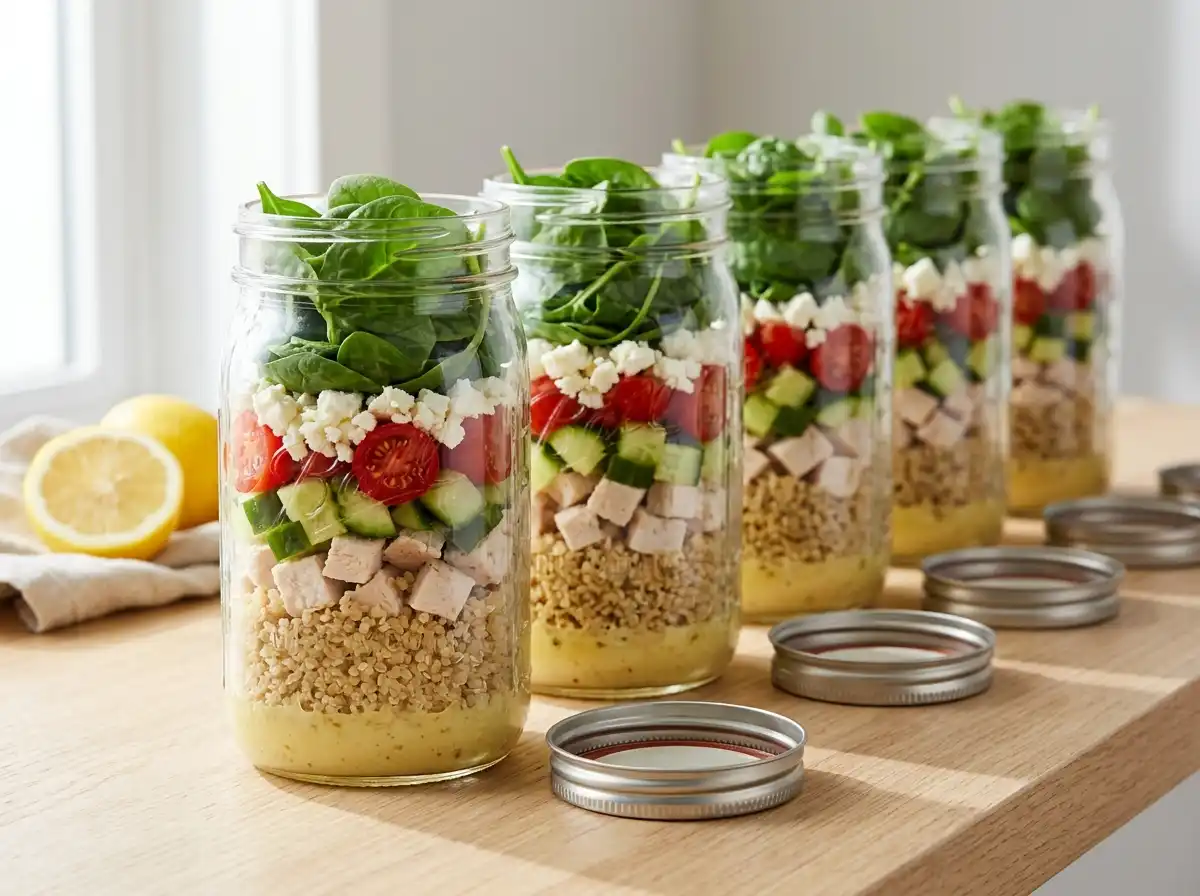
The order is the whole technique. Heaviest and wettest at the bottom, leaves at the top, nothing porous touching the dressing.
- Dressing first. Whisk the lemon juice, olive oil, salt and pepper together, then divide it between the five jars — about 4 teaspoons each.
- Quinoa next. It sits in the dressing on purpose. Quinoa is the one ingredient that improves from soaking in it, and it forms a barrier that keeps the dressing away from everything above.
- Chicken, in an even layer.
- Cucumber and tomatoes, which can handle a little moisture from below.
- Feta and parsley.
- Spinach on top, packed down lightly. It should fill the jar to the shoulder.
Seal, and store the jars upright. A jar on its side lets the dressing run into the greens, which defeats the entire structure.
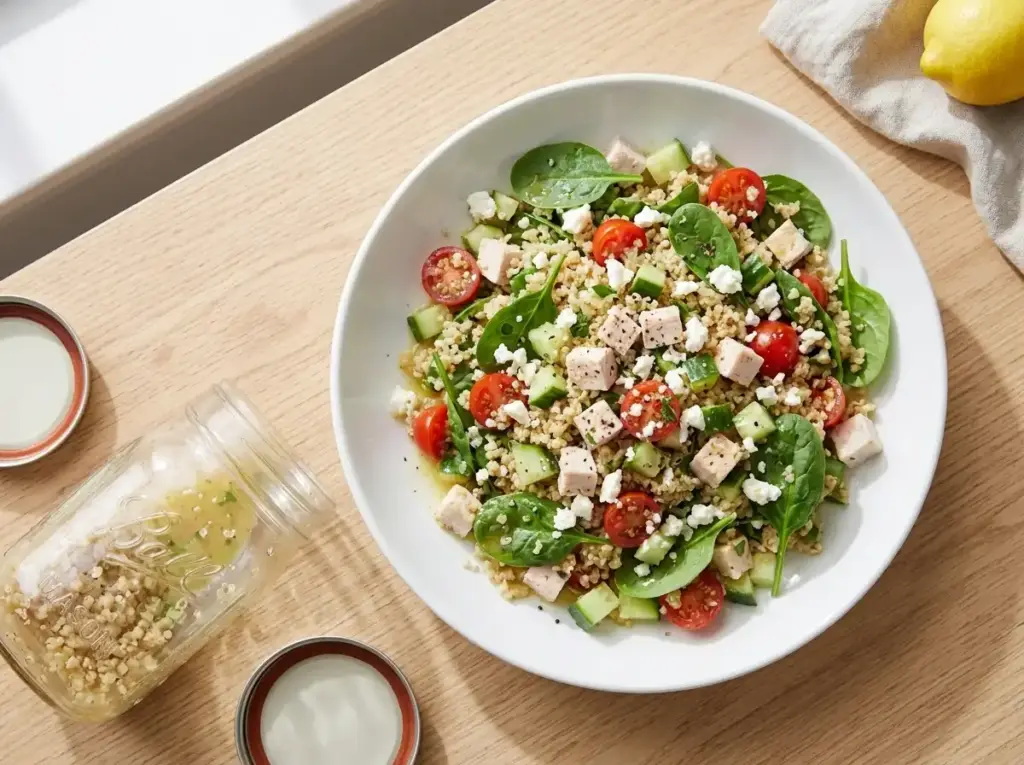
To eat: shake the sealed jar hard, then tip it into a bowl. Eating straight from the jar looks good in photographs but the bottom layers never get dressed properly.
Tips That Decide Whether This Works
The quinoa must be completely cool. This is the single most common failure. Warm grains release steam, the steam condenses on the glass and runs upward, and the spinach at the top is limp within a day. Spread the cooked quinoa on a plate or tray and give it 20 minutes rather than leaving it in the pot.
Dry the spinach thoroughly. Wet leaves shorten the life of the jar as surely as dressing does. A salad spinner, or paper towels and patience.
Salt the quinoa while it’s warm, before it goes in. It’s 80 grams of an otherwise bland ingredient in every jar. Seasoned separately, it changes the finished salad noticeably.
Shake before serving, every time. There’s no mustard in this dressing, so the oil and lemon separate in the fridge. That’s expected, not a fault — a hard shake re-emulsifies it. If you’d rather it held together on its own, add half a teaspoon of Dijon to the dressing.
Substitutions
Rotisserie chicken works and saves half the prep. It carries considerably more sodium than the plain cooked chicken breast these figures are based on — the same trade-off covered in the rotisserie chicken caesar salad.
Feta → goat cheese or cotija. All three hold their texture. Avoid soft mozzarella, which weeps.
Quinoa → farro, bulgur or brown rice. All work structurally. Quinoa carries slightly more protein than the others, so expect the total to drop by a gram or two.
Spinach → kale, if you want five days instead of four. Massage it with a little of the dressing first. Kale is the one green that genuinely improves in a container.
No jars? Use any container with a lid, but keep the dressing in a separate small pot rather than layering it — see the FAQ below.
Storage and Food Safety
Four days, and that’s a maximum rather than a target. Cooked chicken is the limiting ingredient, and the USDA puts refrigerated cooked poultry at three to four days. Jars built on Sunday should be eaten by Thursday.
Two practical consequences: don’t make these on Saturday for the following Friday, and if you want a fifth day of lunches, prepare four jars and keep the fifth portion’s components separate.
Don’t freeze them. Cucumber and tomatoes collapse on thawing, and the spinach turns to slime.

High Protein Chicken and Quinoa Mason Jar Salad
Ingredients
Method
- Make the dressing.
- Whisk the lemon juice, olive oil, salt and black pepper together until combined.
- Divide between five quart-size wide-mouth jars, about 4 teaspoons per jar.
- Layer the jars 3. Add the cooled quinoa on top of the dressing, then the diced chicken in an even layer. 4.
- Add the cucumber and cherry tomatoes, then the feta and parsley. 5. Pack the baby spinach on top, filling the jar to the shoulder. Seal. 6. Store upright in the fridge for up to 4 days. Shake hard and tip into a bowl to serve.
Nutrition
Per jar (recipe makes 5):
| Calories | 445 |
| Protein | 46 g |
| Carbohydrates | 24 g |
| Fiber | 4 g |
| Fat | 18 g |
| Sodium | 587 mg |
These figures are calculated ingredient by ingredient from a USDA-sourced nutrition database and divided by the serving count. They’re calculated values rather than laboratory-tested ones, and they’ll shift with your brands and portions. Chicken and quinoa are cooked weights. Carbohydrates include fiber, following the US convention, so net carbs are about 20 grams per jar. Roughly 40% of the sodium comes from the feta.
Frequently Asked Questions
What size mason jar do I need?
Quart-size, 32 oz, with a wide mouth. Each jar holds 365 grams of food, which is more than a 16 oz jar can take once the quinoa and chicken are in. Wide-mouth jars are also much easier to layer and to empty.
How long do these jar salads last?
Up to 4 days refrigerated, and that’s a maximum rather than a target. Cooked chicken is the limiting ingredient. Store the jars upright so the dressing stays at the bottom, and eat jars built on Sunday by Thursday.
Will the quinoa go soggy sitting in the dressing?
No, and it’s the reason quinoa goes in first. Cooked grains absorb dressing rather than breaking down in it, and they season better for having sat in it overnight. What goes soggy is leaves, which is why the spinach sits at the opposite end of the jar.
Can I use rotisserie chicken instead?
Yes, and it saves about half the preparation time. Rotisserie chicken is brined before roasting, so it carries considerably more sodium than the plain cooked chicken breast these figures are calculated on. How much more varies by store.
Can I make these without mason jars?
Yes, but change the method. In a regular container, layering doesn’t hold — everything shifts as soon as you move it. Pack the salad without dressing and carry the dressing in a small separate pot, adding it just before you eat.
More High Protein Salads
This is one of fifteen recipes in the high protein salad collection, grouped by no-cook, low carb, vegetarian and meal prep, with protein and calories compared across all fifteen.
If you want something faster with no assembly at all, the rotisserie chicken caesar salad takes 15 minutes and carries 44 grams of protein.
Made this? Leave a rating and tell me how it went in the comments — especially if you changed something that worked.
This was really convenient for meal prep. I made all five jars at once and kept the dressing at the bottom as recommended. The vegetables stayed much crisper than they usually do in my prepared salads.