
30g of protein, no protein powder
Quick answer: Whisk 70g of plain Greek yogurt into the egg custard instead of using more milk. Three slices of day-old sourdough, two eggs, and that yogurt give you 30 grams of protein for 557 calories — no protein powder, no protein bread, and no change to how French toast actually tastes.
French toast is usually the opposite of a high protein breakfast. Two slices of white bread soaked in one egg lands somewhere around 12 grams, most of the calories come from the syrup, and you’re hungry by ten.
The fix is smaller than it sounds. Greek yogurt is roughly 10 grams of protein per 100 grams and it’s already the right consistency for a custard. Swap it in for most of the milk and the number nearly triples, while the custard actually gets richer.
Why this recipe works
Three things are doing the work here, and it’s worth knowing which is which.
Greek yogurt replaces milk, not eggs. Standard French toast custard is eggs plus milk. Milk carries 3.3 grams of protein per 100 grams; 2% Greek yogurt carries 10. Swapping 70 grams of one for the other adds about 5 grams on its own, and because yogurt is thicker, the custard clings to the bread instead of running off it.
Three slices instead of two. Bread isn’t a protein source in any meaningful sense, but sourdough still contributes 9.4 grams here — about a third of the total. Two slices would land this recipe under 25 grams.
The custard ratio is deliberate. This uses 190 grams of custard for 105 grams of bread, roughly 1.8 to 1. Most French toast recipes make far more custard than the bread can absorb, and half of it goes down the drain — which also means the nutrition figures on those recipes describe food nobody ate.
Ingredients
Serves 1 · Prep 5 minutes · Cook 15 minutes
| Ingredient | Grams | US measure |
|---|---|---|
| Sourdough bread, day-old | 105g | 3 slices, about 1 inch thick |
| Eggs, large | 100g | 2 |
| Plain Greek yogurt, 2% | 70g | Scant ⅓ cup |
| Milk, 2% | 20g | 1½ tablespoons |
| Vanilla extract | 3g | ¾ teaspoon |
| Ground cinnamon | 1g | ½ teaspoon |
| Unsalted butter | 6g | ½ tablespoon |
| Maple syrup | 10g | 2 teaspoons |
A note on the bread: sourdough is the choice here for structure, not flavor. Its tighter crumb holds up to a thick custard where soft sandwich bread collapses. Day-old is better than fresh — see the FAQ below for why.
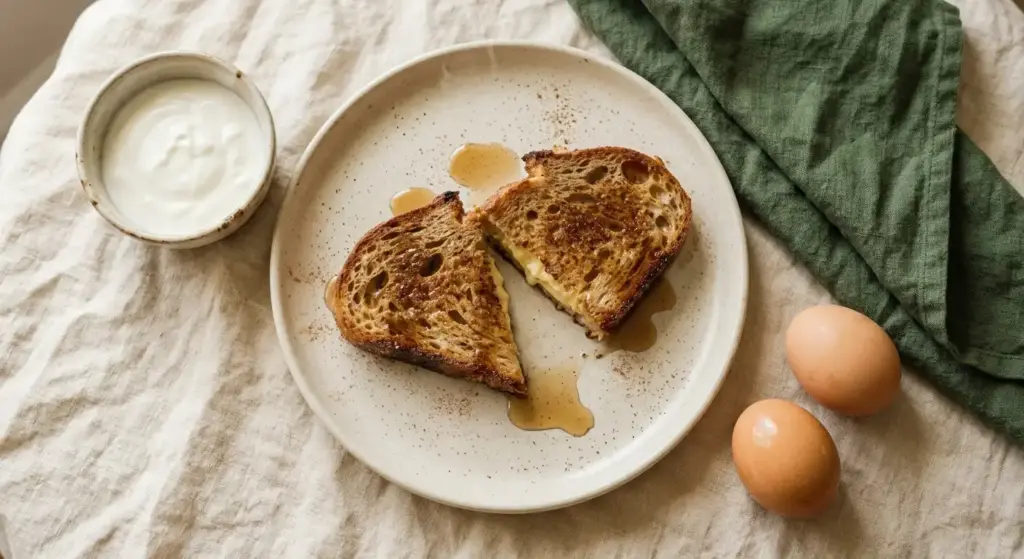
Instructions
- Loosen the yogurt first. Whisk the Greek yogurt and milk together in a wide shallow bowl until completely smooth. Do this before the eggs go anywhere near it.
- Add the eggs, cinnamon and vanilla. Whisk until the custard is one uniform colour with no streaks of white.
- Soak the bread 25 to 30 seconds per side. Day-old sourdough takes about that long. Press it gently into the custard rather than letting it float.
- Heat a skillet over medium-low and melt half the butter. Medium-low, not medium — this matters, and the reason is in the tips.
- Cook 3 to 4 minutes per side, until deeply golden. Add the remaining butter when you flip.
- Rest 1 minute before serving with the maple syrup.
Tips worth knowing
Whisk the yogurt with the milk before adding eggs. Greek yogurt dropped straight into beaten eggs will not disperse — you get pale lumps that never dissolve and end up as chalky spots in the finished toast. Thirty seconds of whisking with the milk first prevents it entirely.
Cook it lower than you think. A yogurt custard has noticeably more protein than a milk custard, and protein browns faster than milk sugar does. On the medium heat that works for regular French toast, this one goes dark on the outside before the middle sets.
Press the bread down; don’t let it float. Sourdough is buoyant. Left alone, the top face barely touches the custard and you get one soaked side and one dry one.
Half the butter now, half at the flip. The first half is mostly gone by the time you turn the slices, and the second side browns unevenly without more.
Substitutions
Every change below is calculated from the same USDA data as the main recipe, so the protein figures are directly comparable.
| Swap | Protein change | Calorie change | Notes |
|---|---|---|---|
| 2 whole eggs → 1 egg + 100g egg whites | +4.6g | −20 | The single most effective change. Custard sets slightly firmer. |
| Greek yogurt → blended cottage cheese, same weight | +0.8g | +17 | Must be blended smooth first, or it curdles visibly. |
| Butter → olive oil | −0.1g | +10 | Works fine; you lose some browning flavour. |
| Skip the maple syrup | 0g | −26 | Cinnamon and vanilla carry it further than you’d expect. |
| Skip the milk, use yogurt alone | −0.7g | −10 | The custard gets noticeably thick. Not recommended. |
What not to substitute: soft white sandwich bread. It doesn’t have the structure for a custard this thick and it disintegrates in the pan. Brioche and challah work, but they’re softer, so cut the soak to 15 seconds a side.
Troubleshooting
Soggy in the middle. Almost always fresh bread rather than day-old. Fresh bread is already saturated with its own moisture and has nowhere to put the custard, so it sits on the surface and then steams. The other cause is heat that’s too high — the outside sets before the centre has time.
Chalky white specks. Yogurt added directly to the eggs instead of being loosened with milk first. There’s no fixing it once cooked; start the custard again.
Dark outside, wet inside. Heat too high. Drop to medium-low and give it an extra minute per side.
The slices fall apart when flipped. Either soaked too long, or the bread was too soft to begin with. Sourdough at 25 to 30 seconds a side should stay intact when you lift it.
Storage and make-ahead
Refrigerator: 3 days in an airtight container, with parchment between the slices.
Freezer: 1 month. Freeze the slices flat on a tray first, then bag them, or they fuse into one block.
Reheating: a toaster is the best method — it re-crisps the outside. A 350°F oven for 8 minutes also works. Avoid the microwave, which turns the egg protein rubbery within thirty seconds.
Making it ahead: the custard can be mixed the night before and kept covered in the fridge. Whisk it briefly before using, since the yogurt settles. Don’t soak the bread in advance — after about ten minutes it stops absorbing and starts breaking down.
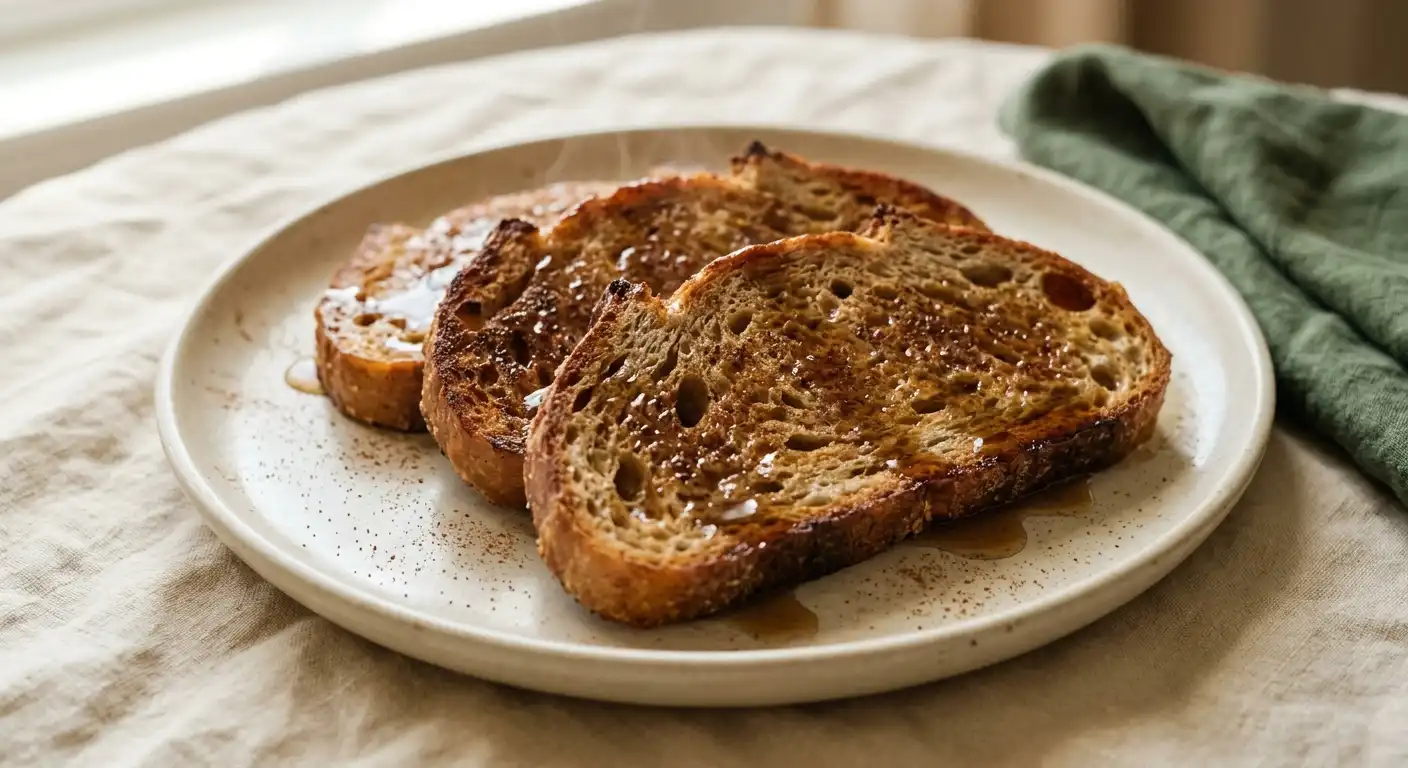

High Protein French Toast
Ingredients
Method
- Loosen the yogurt first. Whisk the Greek yogurt and milk together in a wide shallow bowl until completely smooth. Do this before the eggs go anywhere near it.
- Add the eggs, cinnamon and vanilla. Whisk until the custard is one uniform colour with no streaks of white.
- Soak the bread 25 to 30 seconds per side. Day-old sourdough takes about that long. Press it gently into the custard rather than letting it float.
- Heat a skillet over medium-low and melt half the butter. Medium-low, not medium — this matters, and the reason is in the tips.
- Cook 3 to 4 minutes per side, until deeply golden. Add the remaining butter when you flip.
- Rest 1 minute before serving with the maple syrup.
Notes
- Day-old bread absorbs the custard properly; fresh bread steams instead.
- Medium-low heat matters: a yogurt custard browns faster than a milk one.
- Keeps 3 days refrigerated or 2 months frozen. Reheat in a toaster, not a microwave.
Nutrition
Per serving, calculated from measured gram weights against USDA FoodData Central:
| Per serving | |
|---|---|
| Calories | 557 |
| Protein | 29.8g |
| Carbohydrates | 66.9g |
| Fiber | 3.1g |
| Fat | 17.8g |
| Sodium | 744mg |
On the sodium: 567mg of that 744 comes from the bread alone. Commercial sourdough runs around 540mg per 100 grams, and this recipe uses 105 grams of it. That’s not unusual for any bread-based breakfast, but it’s worth knowing rather than guessing — and it’s the one figure that will move most depending on the loaf you buy. Check the label if sodium is something you track.
Figures will vary with your specific brands and portions.
High Protein French Toast FAQs
How do you add protein to French toast without protein powder?
Replace most of the milk in the custard with plain Greek yogurt. Yogurt carries about 10 grams of protein per 100 grams against milk’s 3.3, and it’s already thick enough to work as a custard base. Seventy grams of Greek yogurt plus two eggs and three slices of sourdough gets this recipe to 30 grams without any powder, protein bread, or supplement.
What bread makes the best French toast?
Sourdough, for structural reasons rather than flavour. A custard this thick needs bread with a tight crumb and enough gluten structure to hold together while it soaks. Brioche and challah also work well and taste richer, but they’re softer, so reduce the soak to about 15 seconds per side. Soft white sandwich bread is the one to avoid — it disintegrates.
Why is my French toast soggy in the middle?
Two causes. The first is fresh bread: it’s already full of its own moisture, so the custard sits on the surface instead of soaking in, then steams during cooking. Day-old bread has dried enough to absorb properly. The second is heat that’s too high, which sets the outside before the centre has cooked. Medium-low is right for a yogurt custard.
Can you make French toast ahead of time?
Yes, in two ways. Cook it fully and refrigerate up to 3 days or freeze up to a month, then reheat in a toaster or a 350°F oven — not a microwave, which makes the egg protein rubbery. Or mix the custard the night before and keep it covered in the fridge. Don’t soak the bread ahead: past about ten minutes it stops absorbing and begins falling apart.
How much protein is in this French toast?
Just under 30 grams per serving — 29.8g, calculated from measured gram weights rather than estimated. The bread contributes 9.4g, the eggs 12.6g, and the Greek yogurt 7g. Swapping one whole egg for 100 grams of egg whites raises it to about 34g.