
Quick answer: This egg salad has 38 grams of protein and 388 calories per serving, with 9 grams of net carbs. It’s bound with cottage cheese and Greek yogurt instead of mayonnaise, which is where about 16 of those grams come from. Six eggs, 20 minutes, serves 2, spooned into romaine leaves.
Standard egg salad is eggs held together with mayonnaise. Mayonnaise is fat and almost nothing else — no protein, no fiber, no useful contribution beyond richness. Replace it with cottage cheese and Greek yogurt and the same bowl gains 16 grams of protein and loses a substantial amount of fat.
Two other things are true about this recipe, and both are worth knowing.
It’s the cheapest recipe on this site by a wide margin. Eggs and cottage cheese are among the least expensive protein sources in any supermarket, and there’s nothing else in here but celery, chives and a head of lettuce.
And at 388 calories it’s the lightest of the low carb recipes in the high protein salad collection, while still carrying 38 grams of protein.
Why This Egg Salad Has 38 Grams of Protein
| Source | Per serving |
|---|---|
| Eggs (3 large) | 18.9 g |
| Cottage cheese (100 g) | 11.1 g |
| Greek yogurt (50 g) | 5.0 g |
| Dijon, celery, chives, romaine | 2.6 g |
| Total | 37.6 g |
Three eggs is a normal portion and gives you 19 grams. That’s a decent snack, not a meal.
The binding is what doubles it. Cottage cheese at 11 grams per 100 g and Greek yogurt at 10 grams per 100 g together add 16 grams — as much as the eggs minus one. Mayonnaise in the same quantity would add about 0.5 grams of protein and roughly 200 calories.
This is the single most efficient swap in the collection: same texture, same job, dramatically different numbers.
The Cottage Cheese Question
Cottage cheese is lumpy, and egg salad shouldn’t be. This is the step that decides whether the recipe works.
Blend it. Two hundred grams of 4% cottage cheese blitzed in a small blender or food processor for thirty seconds becomes completely smooth — indistinguishable in texture from a thick, mild cream cheese, with none of the curd. This is what makes the salad taste like egg salad rather than like eggs with cottage cheese in it.
If you don’t have a blender, press it through a fine sieve with the back of a spoon. It takes two minutes and gets you most of the way.
Failing that, buy small-curd cottage cheese and mash it hard with a fork against the side of the bowl before anything else goes in. The texture won’t be as smooth, and the salad is still perfectly good.
Use 4%, not low fat. Low-fat cottage cheese releases water as it sits, and a watery egg salad by lunchtime is a specific kind of disappointment. The fat also carries the flavor of the mustard and chives.
What You Need
Serves 2.
For the egg salad
- 6 large eggs (300 g)
- Scant 1 cup 4% cottage cheese (200 g)
- Scant ½ cup plain 2% Greek yogurt (100 g)
- 2 tablespoons Dijon mustard (30 g)
- ½ cup finely diced celery (60 g)
- ⅓ cup chopped chives (20 g)
- ½ teaspoon freshly ground black pepper
- 1 teaspoon paprika (2 g)
To serve
- 8 large romaine leaves (200 g)
Notes on the ones that matter:
Two tablespoons of Dijon is assertive, and deliberately so — it’s what stops a bowl of eggs and dairy tasting flat. It also contributes 525 mg of sodium to the recipe. Halving it takes about 131 mg off each serving, at some cost to the flavor.
Celery, finely diced. The only crunch in the bowl. Cut it small — pieces bigger than a pea sit awkwardly against soft egg.
Romaine hearts, whole leaves. They’re rigid enough to hold a filling without tearing. Butter lettuce is prettier and collapses; iceberg works but adds nothing.
Paprika is not decoration. A teaspoon stirred through, plus a dusting on top, gives the salad a warmth that mustard alone doesn’t.
How to Make It
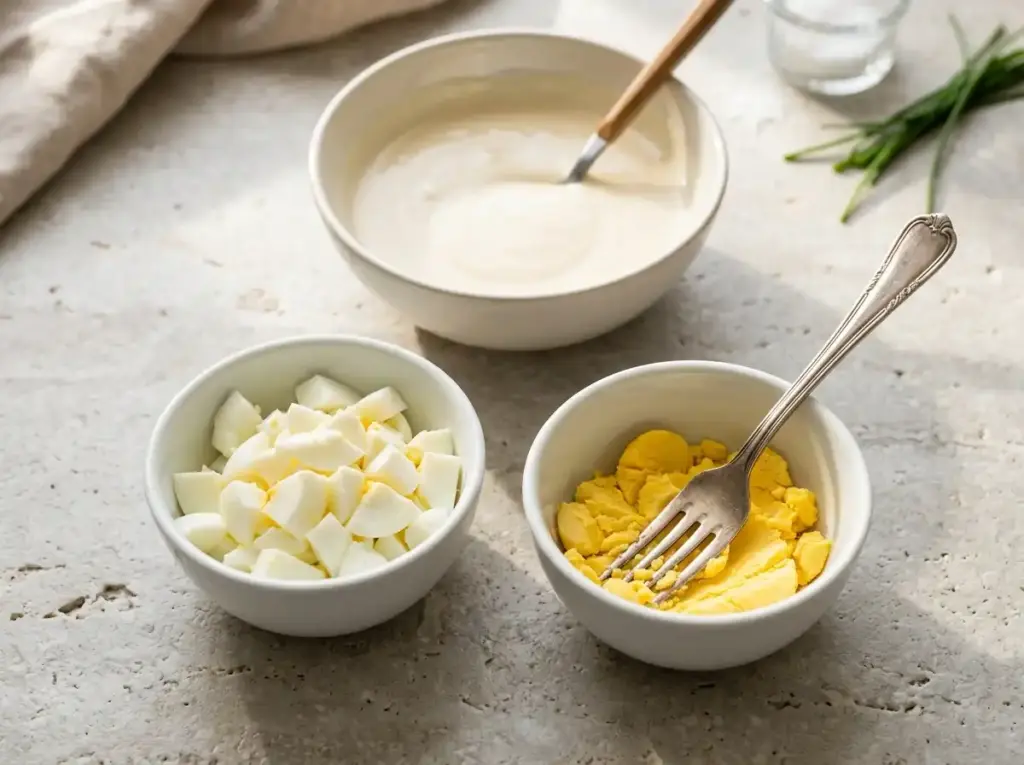
- Boil the eggs for 8 minutes from the moment the water returns to a boil, then move them straight into cold water. Eight minutes gives a yolk that’s set but still slightly creamy, which mashes better than a fully firm one.
- Blend the cottage cheese until completely smooth, then stir in the Greek yogurt, Dijon, black pepper and paprika.
- Peel the eggs and separate them. Chop the whites into rough pieces. Mash the yolks separately with a fork.
- Fold the mashed yolks into the dressing first, until it’s uniform and pale yellow.
- Add the chopped whites, celery and chives and fold two or three times only.
- Spoon into the romaine leaves and dust with a little more paprika.
Why Separate the Whites and Yolks
It sounds fussy and it takes an extra minute, so it’s worth knowing what it buys you.
Yolks and whites have completely different textures. Yolks are soft and emulsify into a dressing; whites are firm and want to stay in pieces. Mash them together and everything becomes a uniform paste — which is what most supermarket egg salad is, and why it’s unpleasant.
Mashing the yolks into the dressing turns them into part of the sauce. Folding the whites in at the end keeps them as distinct pieces you can feel. The result is an egg salad with texture rather than a spread.
The same logic explains the last instruction: fold two or three times, then stop. Every extra turn breaks the whites down further.
Tips
Cold water immediately, and don’t skip it. Eggs keep cooking in their own heat. Straight into cold water is also what makes them peel cleanly — the shock separates the membrane from the white.
Older eggs peel better. A week-old egg peels far more easily than one bought that morning. This is the one recipe where the older carton at the back of the fridge is the right choice.
Assemble the cups at the last minute. The filling keeps well; the lettuce doesn’t. Filled leaves go limp within about half an hour.
Taste before adding salt. Between the cottage cheese and the Dijon, there’s already 1,253 mg of sodium in the bowl before anything else. Most versions need pepper and lemon rather than salt.
Substitutions
Greek yogurt only, skipping the cottage cheese, works and is simpler. It costs you about 5 grams of protein per serving and gives a tangier, looser salad.
Ricotta instead of cottage cheese is smoother out of the tub and needs no blending, but carries less protein.
Scallions or dill instead of chives. Both work. Dill in particular is very good with egg.
Serve it on bread if the lettuce cups aren’t the point for you. That obviously changes the carbohydrate figure — a slice of wholegrain bread adds roughly 15 grams — but the protein stays where it is.
Add-ins worth trying: capers, a chopped cornichon, a pinch of curry powder, or hot sauce stirred into the dressing.
Storage
The filling keeps 3 days refrigerated. Assembled cups do not keep at all.
Store the egg salad in a sealed container and keep the romaine separate, wrapped in a paper towel inside a bag. Assembly takes a minute.
The salad tightens in the fridge as the eggs absorb moisture from the dressing. A spoonful of yogurt stirred through on day two loosens it again.
Don’t freeze it. Egg whites turn rubbery and the dairy splits.
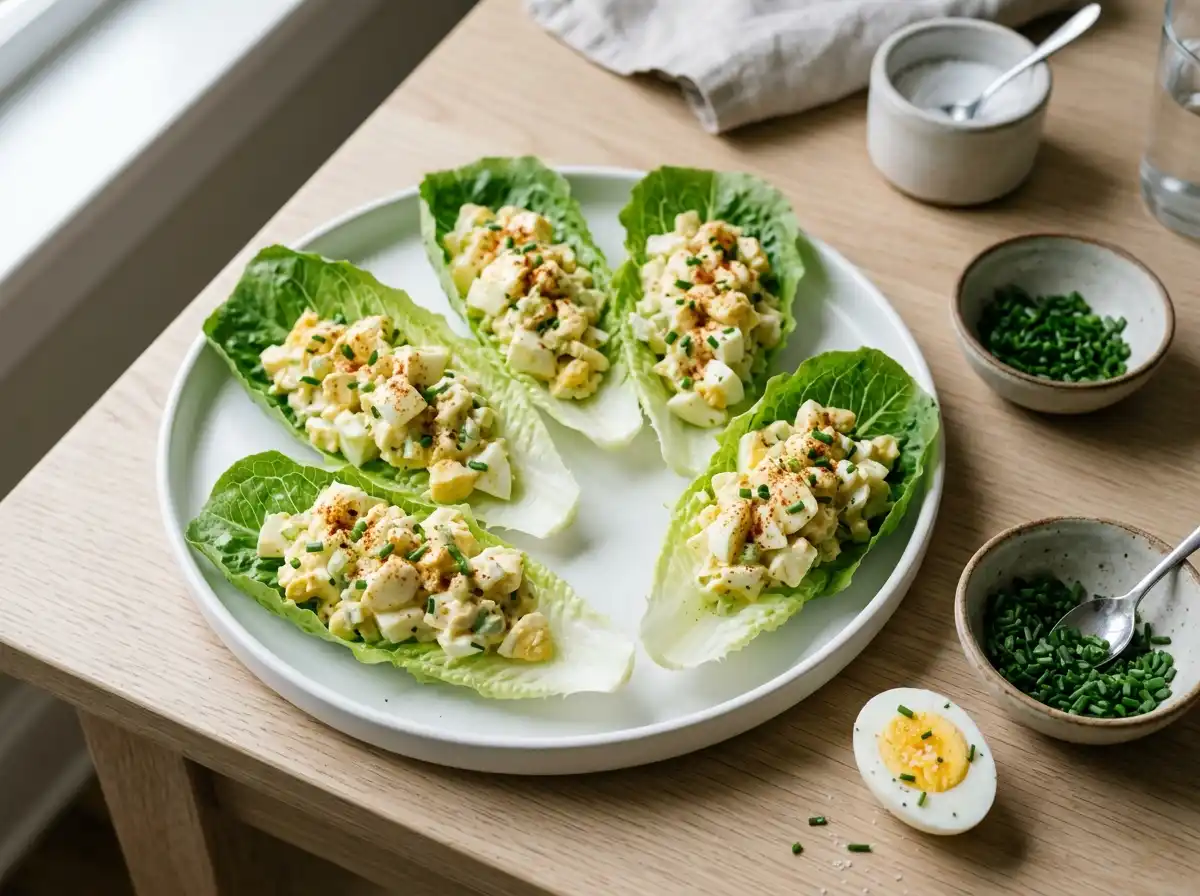
High Protein Egg Salad Lettuce Cups
Ingredients
Method
- Boil the eggs for 8 minutes from the moment the water returns to a boil, then transfer them straight into cold water and leave until completely cool.
- Blend the cottage cheese until smooth, then stir in the Greek yogurt, Dijon mustard, black pepper and paprika.
- Peel the eggs. Chop the whites into rough pieces and mash the yolks separately with a fork.
- Fold the mashed yolks into the dressing until uniform, then add the chopped whites, celery and chives and fold two or three times only.
- Spoon the egg salad into the romaine leaves and dust with a little extra paprika. Assemble just before eating.
Notes
- Blending the cottage cheese is what gives this the texture of mayonnaise-based egg salad. A fine sieve works if you have no blender.
- Use 4% cottage cheese. Low fat releases water and thins the salad out.
- Halving the Dijon takes about 131 mg of sodium off each serving.
- The filling keeps 3 days. Keep the lettuce separate and fill the leaves just before serving.
Nutrition
Per serving (recipe makes 2):
| Calories | 388 |
| Protein | 38 g |
| Carbohydrates | 13 g |
| Fiber | 4 g |
| Fat | 21 g |
| Sodium | 890 mg |
These figures are calculated ingredient by ingredient from a USDA-sourced nutrition database and divided by the serving count. They’re calculated values rather than laboratory-tested ones, and they’ll shift with your brands — cottage cheese in particular varies in both protein and salt. One large egg is 50 g without the shell. Carbohydrates include fiber, following the US convention, so net carbs are about 9 grams per serving.
The sodium comes almost entirely from three ingredients: cottage cheese at 728 mg, Dijon at 525 mg and the eggs themselves at 426 mg across the whole recipe. No salt is added.
Frequently Asked Questions
How do you make egg salad without mayonnaise?
Blend cottage cheese until completely smooth and combine it with Greek yogurt and Dijon mustard. The texture is close to mayonnaise-based egg salad, and the difference in the numbers is substantial — this version carries 38 grams of protein per serving where a mayonnaise version of the same size would be closer to 22.
How much protein is in egg salad?
Three large eggs supply about 19 grams. This version reaches 38 because the binding is cottage cheese and Greek yogurt rather than mayonnaise, which adds a further 16 grams. Mayonnaise contributes essentially no protein.
Why do you mash the yolks separately from the whites?
Yolks emulsify into the dressing and whites hold their shape. Mashed together, everything becomes a uniform paste. Mashing the yolks into the dressing first and folding the chopped whites in at the end gives you an egg salad with texture rather than a spread.
How long does this egg salad keep?
The filling keeps 3 days refrigerated in a sealed container. Assembled lettuce cups don’t keep at all — the leaves go limp within about half an hour, so fill them just before eating.
Is egg salad low carb?
This version is. At 13 grams of total carbohydrate and 4 grams of fiber, net carbs come to about 9 grams per serving, and serving it in romaine leaves rather than on bread is what keeps it there.
More High Protein Salads
This is one of fifteen recipes in the high protein salad collection, grouped by no-cook, low carb, vegetarian and meal prep, with protein and calories compared across all fifteen.
For another low carb option with a higher protein number, the turkey cobb salad delivers 53 grams at 5 grams of net carbs.
Made this? Leave a rating and tell me how it went in the comments — especially if you changed something that worked.

I liked the texture much more than regular egg salad. Keeping the egg whites chopped and the yolks mashed made a noticeable difference, and the lettuce cups gave it a nice crunch.