
Quick answer: This savory oatmeal has 34 grams of protein and 562 calories per serving, and takes about 20 minutes. Oats cooked like a savory grain — broth instead of water, eggs stirred in off the heat, parmesan and a soft egg on top — no protein powder. Serves 1.
Oatmeal doesn’t have to be sweet. Treated as a savory base instead — cooked in broth, finished with cheese and egg — it behaves less like a breakfast cereal and more like risotto or congee.
The protein math works out well this way too. A bowl of sweetened oatmeal with milk carries maybe 10 to 12 grams. Add two eggs stirred through and a soft egg on top, along with parmesan, and the same bowl of oats reaches 34.
Why This Oatmeal Has 34 Grams of Protein
| Source | Per serving |
|---|---|
| Eggs (150g, 3 total: 2 stirred in + 1 on top) | 18.9 g |
| Oats (50g) | 6.6 g |
| Parmesan (20g) | 7.2 g |
| Spinach and everything else | 1.7 g |
| Total | 34.4 g |
Three eggs do more than half the work, split between two techniques. Two are beaten and stirred into the oats off the heat, custard-style; the third is soft-boiled and placed on top. That combination is what separates this from a plain bowl of savory oats — see the method below for why it’s done this way rather than all one way or the other.
Parmesan contributes more protein than you’d expect from a garnish, at 7.2 grams from just 20 grams of cheese. It’s also the largest sodium contributor in the dish, addressed below.
Why This Isn’t Three Soft-Boiled Eggs
The original idea for this recipe used three soft-boiled eggs on a bowl of oatmeal, and it doesn’t actually work as a dish — three runny yolks over porridge is more than the bowl can hold, and it’s awkward to eat.
The better method splits the technique. Two eggs are beaten and stirred into the hot oats off the heat, the way you’d finish a carbonara — the residual warmth cooks them into a glossy, custardy coating rather than curds. The third egg is cooked separately, soft-boiled, and placed whole on top for the visual and textural contrast of a runny yolk.
This gets the same three eggs’ worth of protein into a bowl that’s actually pleasant to eat, rather than a technically correct but impractical stack of eggs.
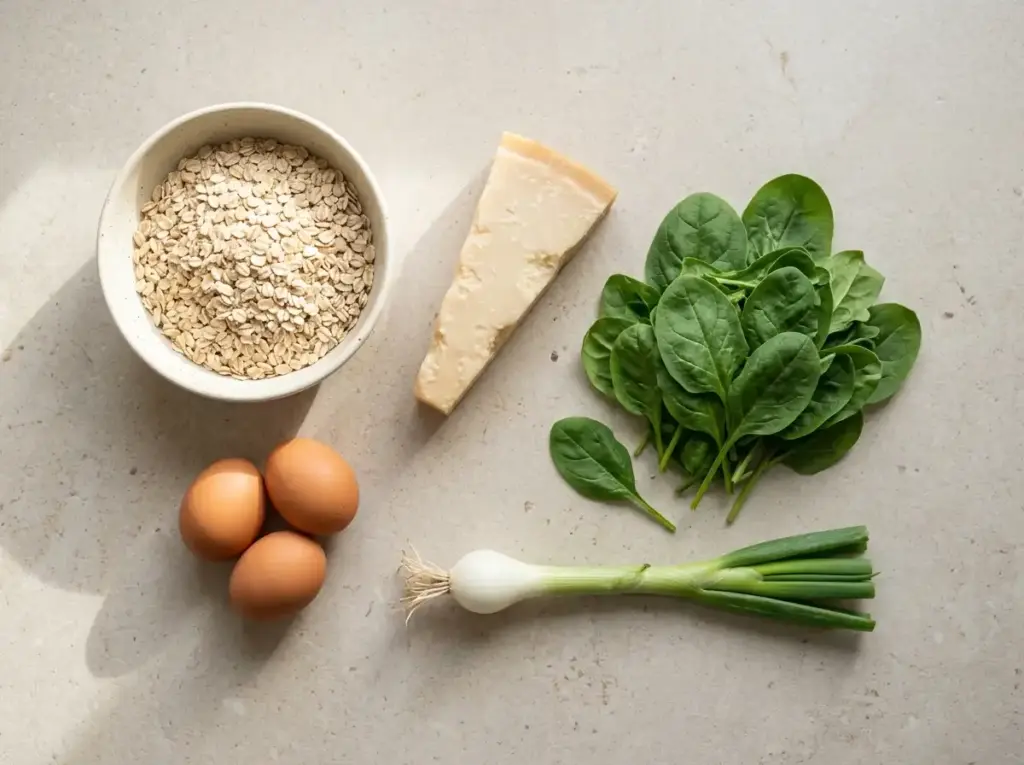
What You Need
- ½ cup rolled oats (50g)
- 3 large eggs — 2 for stirring in, 1 for soft-boiling (150g total)
- ¼ cup grated parmesan (20g)
- 1 packed cup spinach (50g)
- 1½ teaspoons olive oil (7g)
- 1 spring onion, sliced (15g)
- A small pinch of salt (0.5g)
- ¼ teaspoon black pepper (0.5g)
Notes on the ones that matter:
Cook the oats in broth if you have it, water if you don’t. Broth adds a savory depth that plain water can’t, though the protein and calorie figures here are calculated on water for consistency — broth will shift the sodium slightly depending on the brand.
Reduced salt is deliberate. Parmesan is already assertively salty, and adding a full seasoning’s worth of salt on top of it oversalts the dish quickly. This recipe uses less than half what a typical savory oatmeal might call for.
How to Make It
- Bring water or broth to a simmer and stir in the oats. Cook 5 to 6 minutes, stirring occasionally, until thick and creamy.
- Meanwhile, soft-boil one egg: lower it into simmering water, cook exactly 6 minutes, then transfer to an ice bath.
- Sauté the spinach in the olive oil for 1 to 2 minutes, just until wilted, and set aside.
- Off the heat, whisk two eggs and stir them into the hot oats, mixing constantly for 30 seconds until they turn glossy and custardy rather than clumping into curds.
- Stir in the parmesan, spinach and spring onion.
- Peel the soft-boiled egg, halve it, and place it on top. Finish with salt and pepper.
Twenty minutes, most of it at the stove.
Tips
Off the heat matters more than usual here. Stirring beaten eggs into oats that are still over direct heat scrambles them into curds almost immediately — the oats are too hot for a gentle custard to form. Pull the pot off the burner first, then stir.
Don’t skip the ice bath for the soft-boiled egg. It stops the cooking precisely at 6 minutes, which is what keeps the yolk runny. Left in the hot water even a minute longer, it moves noticeably toward fully set.
Season with pepper more than salt. Between the parmesan and the eggs, this dish is naturally well-seasoned. Taste before adding beyond the small pinch called for here.
Warm the bowl if serving right away. Savory oatmeal cools faster than you’d expect once eggs and cheese are stirred through, since the volume drops the overall temperature quickly.
Substitutions
Every figure below is per serving, calculated from the same USDA data as the main recipe.
| Swap | Protein | Calories | Sodium | Notes |
|---|---|---|---|---|
| Add 20g hemp seeds | +6.3 g | +111 | 0 | The most effective addition without touching the eggs or cheese. |
| Parmesan 20g → 30g | +3.6 g | +39 | +153mg | More flavour and protein, proportionally more sodium too. |
| Oats 50g → 40g | −1.3 g | −38 | 0 | Lighter bowl, less filling. |
| Parmesan → 50g feta | −0.1 g | +54 | +252mg | Similar protein, notably higher sodium and a different flavour profile entirely. |
What not to substitute: don’t replace the technique of stirring eggs in off the heat with just cracking a raw egg into the hot pot. That produces scrambled curds throughout the oats rather than the glossy custard this recipe is built around.
Storage
This is best made and eaten immediately. The custardy texture from the off-heat eggs doesn’t hold — reheated, the eggs firm up and lose the silky quality that makes this work.
If you must reheat: low heat in a pan with a splash of water or milk stirred in, which loosens the oats back toward their original texture. The eggs won’t return to quite the same glossiness.
What can be prepped ahead: the spinach can be sautéed the night before and reheated briefly. The soft-boiled egg is best cooked fresh, since a reheated soft-boiled egg overcooks the yolk almost immediately.
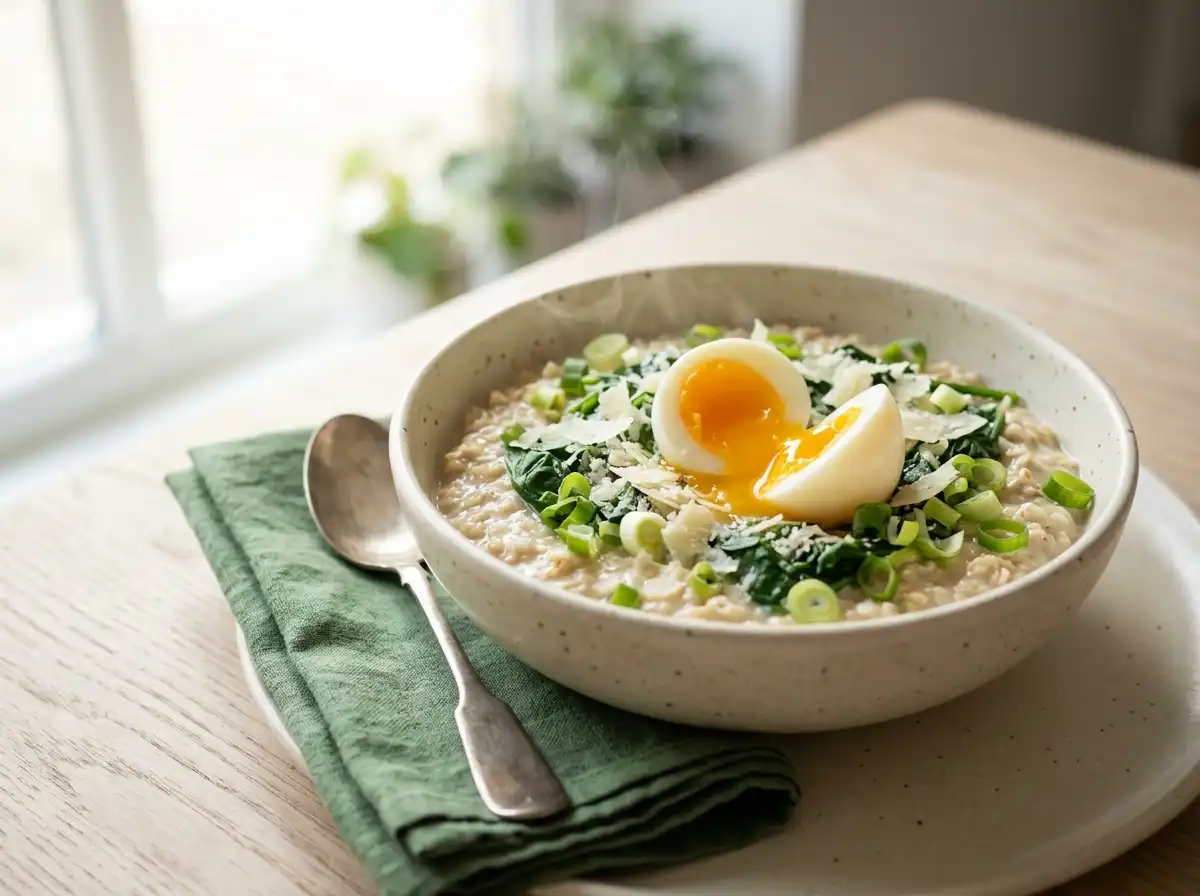

Savory Oatmeal With Egg and Parmesan
Ingredients
Method
- Bring water or broth to a simmer and stir in the oats. Cook 5 to 6 minutes, stirring occasionally, until thick and creamy.
- Meanwhile, soft-boil one egg: lower it into simmering water, cook exactly 6 minutes, then transfer to an ice bath.
- Sauté the spinach in the olive oil for 1 to 2 minutes, just until wilted, and set aside.
- Off the heat, whisk two eggs and stir them into the hot oats, mixing constantly for 30 seconds until they turn glossy and custardy rather than clumping into curds.
- Stir in the parmesan, spinach and spring onion.
- Peel the soft-boiled egg, halve it, and place it on top. Finish with salt and pepper.
Nutrition
Per serving (recipe makes 1):
| Calories | 562 |
| Protein | 34 g |
| Carbohydrates | 39 g |
| Fiber | 7 g |
| Fat | 30 g |
| Sodium | 758 mg |
These figures are calculated ingredient by ingredient from a USDA-sourced nutrition database and divided by the serving count. They’re calculated values rather than laboratory-tested ones, and they’ll shift with your brands — using broth instead of water will change the sodium figure depending on what you use. Carbohydrates include fiber, following the US convention, so net carbs are about 32 grams per serving.
On the sodium: parmesan contributes 306mg and the small amount of added salt another 194mg — together the majority of the total. This recipe already uses less added salt than a typical savory oatmeal specifically because the parmesan carries so much on its own; adding a full seasoning’s worth on top would push this considerably higher without improving the flavour proportionally.
Frequently Asked Questions
Can oatmeal be savory?
Yes, and it’s a long-standing preparation in several culinary traditions, closer to congee or a loose risotto than the sweet version most familiar in the US. Cooking oats in broth rather than milk, and finishing with cheese, egg or vegetables instead of fruit and sugar, produces a completely different but equally traditional dish.
What can I put in savory oatmeal?
Cheese, eggs and sautéed greens are the base of most savory oatmeal, similar to this recipe’s parmesan, egg and spinach. Other common additions include a fried egg instead of soft-boiled, crumbled bacon, sautéed mushrooms, or a drizzle of chili oil. The oats themselves take on whatever direction the toppings set.
How do you make oatmeal taste savory?
Cook the oats in broth instead of water or milk, which is the single biggest flavour difference. From there, finishing with salty, savory toppings — parmesan, a soft egg, sautéed greens — completes the shift. Sugar, cinnamon and fruit have no place in this version; salt, fat and umami do the work instead.
Is savory oatmeal good for weight loss?
It can fit into a calorie-conscious approach the same way any protein-forward meal can, since protein tends to be more satiating than carbohydrate or fat at the same calorie level. This particular version isn’t especially low in calories at 562 per serving, driven mainly by the parmesan and olive oil, so it’s worth thinking of as a substantial meal rather than a light one.
More High Protein Breakfasts
This is one of fifteen recipes in the high protein breakfast collection, grouped by savory, sweet and make-ahead, with protein, calories and sodium compared across all fifteen.
For another savory, egg-forward breakfast with a completely different base, savory tofu scramble reaches even higher protein and is fully vegan.
If mornings are tighter on time, scrambled eggs with cottage cheese uses a similar egg-forward approach in half the time.
Made this? Leave a rating and tell me if you tried it with broth instead of water — I’d be curious how much difference it makes for you.