
Quick answer: This breakfast casserole has 40 grams of protein and 373 calories per serving across six servings, and takes about 50 minutes including the bake. It leaves out the bread that most casseroles use as filler, which is what makes the protein-to-calorie ratio the best of any recipe in the collection. It can be assembled the night before.
Most breakfast casseroles are built on bread. Cubed sourdough, torn croissants, hash browns — the custard soaks into starch and the result is a strata, which is a fine thing to eat and a poor way to reach 40 grams of protein.
Take the bread out and the same dish becomes something else. The eggs still set, the texture is closer to a crustless quiche, and the calories drop by roughly a third while the protein stays where it is.
One bake covers six breakfasts, which is the other reason to make it.
Why This Casserole Has 40 Grams of Protein
| Source | Per serving | Share |
|---|---|---|
| Turkey breast, cooked (67 g) | 20.1 g | 50% |
| Eggs (100 g, 2 large) | 12.6 g | 31% |
| Cheddar cheese (25 g) | 5.7 g | 14% |
| Milk, vegetables | 1.9 g | 5% |
| Total | 40.4 g |
Turkey does half the work. Four hundred grams of cooked turkey breast across the dish carries 120 grams of protein for 588 calories. Nothing else in the collection is that efficient — turkey breast is roughly 30% protein by weight with almost no fat.
Removing the bread is what makes the ratio work. Two cups of cubed bread would add around 400 calories across the dish and about 12 grams of protein. That moves the number in the wrong direction, which is why this recipe leaves it out entirely rather than reducing it.
A Note on Sodium
This carries 572 mg of sodium per serving, about 25% of the World Health Organization’s 2,300 mg daily limit. That’s mid-range for the collection and mostly avoidable.
Per serving, it breaks down as:
- Added salt: 194 mg
- Cheddar cheese: 163 mg
- Eggs: 142 mg
- Turkey and milk: 58 mg
What actually helps: skip the added salt entirely. That takes the dish to 378 mg without changing anything else, and the cheddar seasons more than people expect — 150 grams of it across six servings carries real salt. Taste before you add. Swapping cheddar for Gruyère removes another 79 mg per serving and adds protein.
What doesn’t help: using less cheese overall. You lose 5.7 grams of protein per serving to save 163 mg, which is a poor trade in a recipe built around the protein number.
What You Need
- 12 large eggs (600 g)
- 3 cups cooked turkey breast, diced (400 g)
- 1½ cups shredded cheddar cheese (150 g)
- ¾ cup + 1 tablespoon milk, 2% (200 g)
- 1 large red bell pepper, diced (150 g)
- 3 packed cups spinach (100 g)
- 4 spring onions, sliced (40 g)
- ½ teaspoon salt (3 g)
- 1 teaspoon black pepper (2 g)
Notes on the ones that matter:
Turkey breast, or rotisserie chicken breast. Chicken is easier to find and nearly identical in protein. Use breast meat only — thigh and skin change the fat and sodium figures noticeably.
The 3:1 egg-to-milk ratio. Six hundred grams of egg to 200 grams of milk is what sets reliably. More milk and the custard weeps.
Spinach, and it has to be squeezed. This is the whole recipe. Details below.
How to Make It
- Wilt the spinach and squeeze it dry. Thirty seconds in a hot dry pan, then wring it out in a clean towel.
- Sauté the bell pepper 4 to 5 minutes until it softens and gives up its water. Add the spring onions for the last minute.
- Preheat the oven to 350°F (175°C) and grease a 9×13 inch dish.
- Whisk the eggs, milk, salt and pepper until completely uniform, with no streaks of white.
- Scatter the turkey, vegetables and two-thirds of the cheese across the dish, pour the egg mixture over, and top with the remaining cheese.
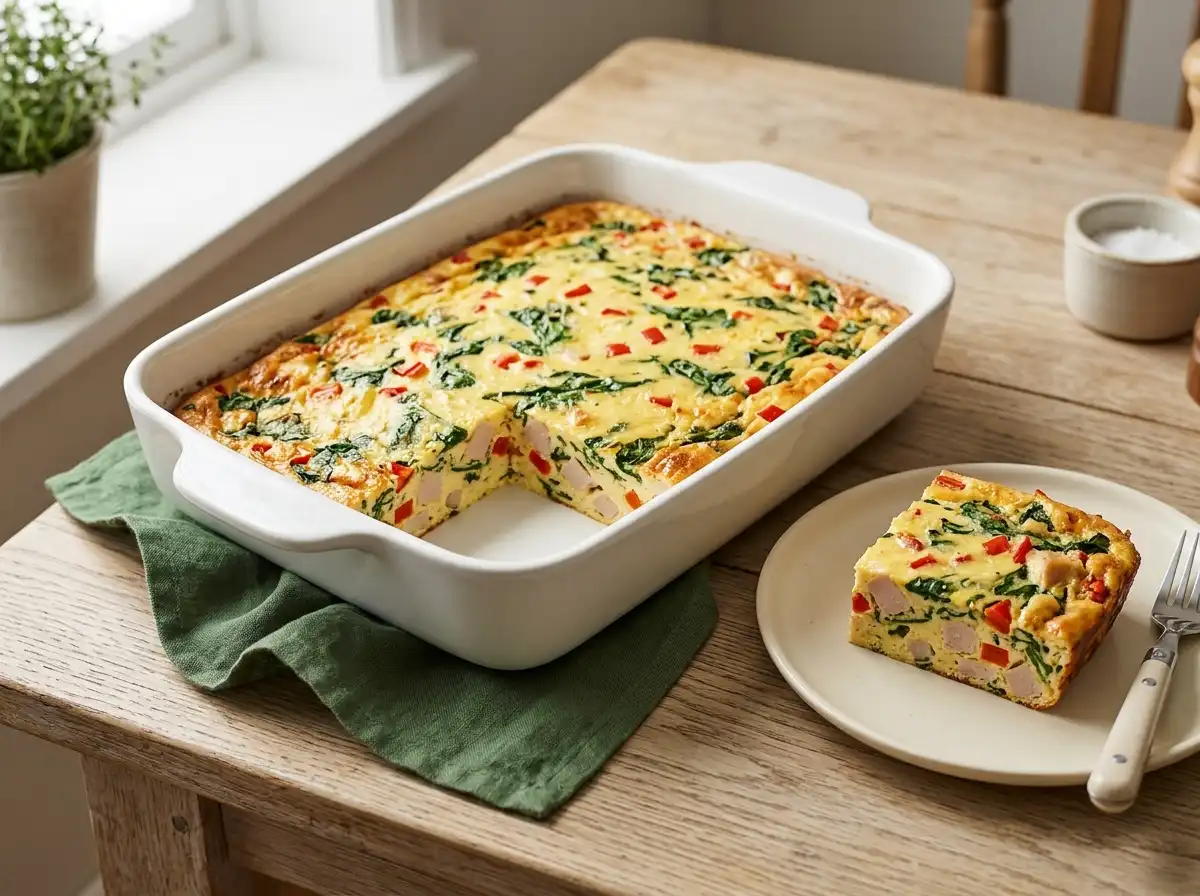
- Bake 35 minutes, until the centre is set and barely jiggles. A knife inserted 2 inches from the centre should come out clean.
- Rest 10 minutes before cutting.
Fifteen minutes of prep, thirty-five in the oven.
Tips
Squeeze the spinach. This is the whole recipe. One hundred grams of raw spinach holds a startling amount of water, and in an egg custard that water has nowhere to go — it separates out and pools under the slices. Wilting alone isn’t enough; it has to be wrung out in a towel. The peppers get sautéed for the same reason.
Rest it 10 minutes before cutting. Egg custard carries on setting off the heat. Cut it straight from the oven and the centre slumps; cut it after ten minutes and the slices hold their shape.
Two-thirds of the cheese under, one-third on top. Cheese buried in the custard melts into it and seasons the whole dish. Cheese on top browns. You want both, and putting it all on top gives you neither.
Pull it while it still jiggles slightly. Overbaked egg custard turns rubbery and weeps water on reheating, which is the most common reason a casserole is worse on day three than day one.
Substitutions
Every figure below is per serving, calculated from the same USDA data as the main recipe.
| Swap | Protein | Calories | Sodium | Notes |
|---|---|---|---|---|
| Cheddar → Gruyère | +1.7 g | +2 | −79 mg | Better melt, less salt, more protein. The best swap here. |
| Milk → blended cottage cheese, same weight | +2.6 g | +16 | +106 mg | Richer, denser set. Blend smooth first. |
| 12 eggs → 8 eggs + 300 g egg whites | +1.2 g | −22 | +36 mg | Lighter and leaner. Slightly firmer set. |
| Skip the added salt | 0 g | 0 | −194 mg | Try it before adding. The cheddar carries more than you’d expect. |
| Turkey → firm tofu, same weight | −8.5 g | −2 | −33 mg | Still lands at 32 g. Press and cube the tofu first. |
What not to substitute: don’t add bread back in as a “just a little” measure. If you want a strata, make a strata — this recipe is built around not having one.
Storage
Assemble the night before. Prepare everything through step 5, cover, and refrigerate up to 12 hours, then add 5 to 8 minutes to the bake time since it goes in cold. Don’t go beyond 12 hours — the salt starts drawing water out of the vegetables and you’re back to a watery custard.
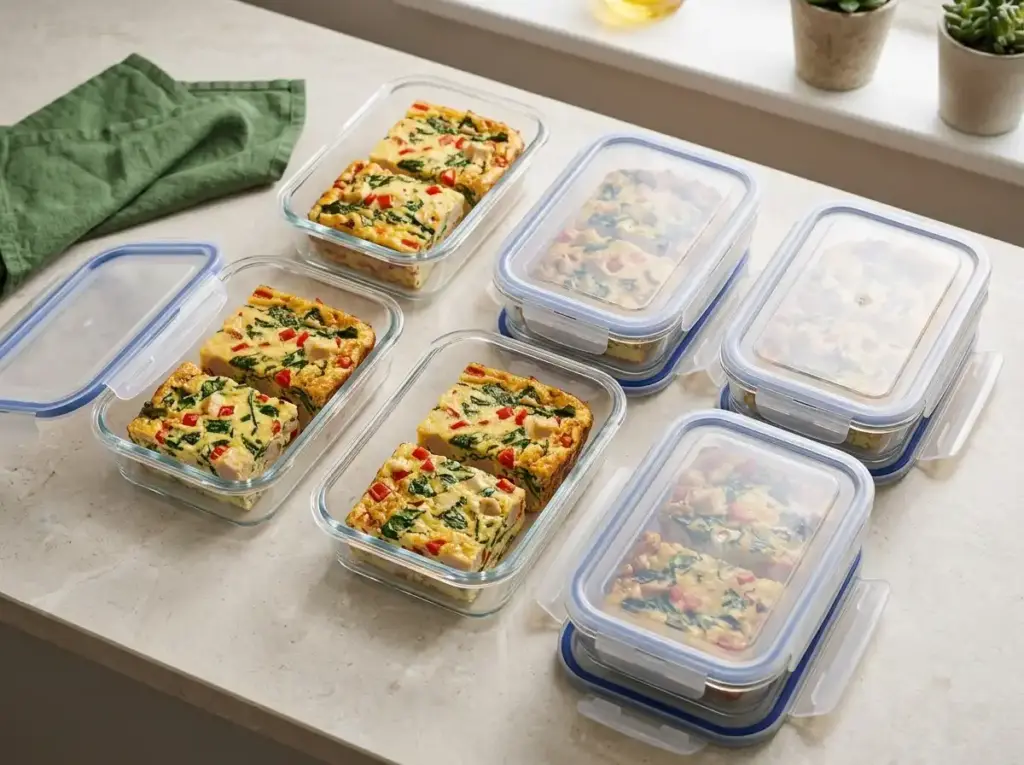
Four days refrigerated, cut into six portions in airtight containers.
Two months frozen, cut into portions and wrapped individually. A whole frozen casserole is impractical to thaw evenly. Thaw overnight in the fridge before reheating.
Reheat covered at 300°F for 15 minutes. The microwave works in 90 seconds at 50% power — full power overcooks the egg and turns it rubbery within a minute.

High Protein Breakfast Casserole
Ingredients
Method
- Wilt the spinach in a hot dry pan for 30 seconds, then wring it out in a clean towel until dry.
- Sauté the bell pepper 4 to 5 minutes until softened, adding the spring onions for the last minute.
- Preheat the oven to 350°F (175°C) and grease a 9×13 inch dish.
- Whisk the eggs, milk, salt and pepper until uniform with no streaks of white.
- Scatter the turkey, vegetables and two-thirds of the cheese in the dish. Pour over the egg mixture and top with the remaining cheese.
- Bake 35 minutes, until the centre is set and barely jiggles.
- Rest 10 minutes before cutting into six portions.
Notes
- Squeezing the spinach dry is the single step that prevents a watery casserole.
- Can be assembled up to 12 hours ahead; add 5 to 8 minutes to the bake time if baking from cold.
- Keeps 4 days refrigerated or 2 months frozen in individual portions.
Nutrition
Per serving (recipe makes 6):
| Calories | 373 |
| Protein | 40 g |
| Carbohydrates | 6 g |
| Fiber | 1 g |
| Fat | 20 g |
| Sodium | 572 mg |
These figures are calculated ingredient by ingredient from a USDA-sourced nutrition database and divided by the serving count. They’re calculated values rather than laboratory-tested ones, and they’ll shift with your brands. Carbohydrates include fiber, following the US convention, so net carbs are about 5 grams per serving.
At 40 grams of protein for 373 calories, this is the best protein-to-calorie ratio of the fifteen recipes in the collection. It’s also the lowest in carbohydrate, at 6 grams, because there’s no bread in it.
Frequently Asked Questions
Can you make breakfast casserole the night before?
Yes. Assemble everything, cover, and refrigerate up to 12 hours, then add 5 to 8 minutes to the bake time since the dish goes in cold. Beyond about 12 hours the salt starts drawing water out of the vegetables and the custard turns watery — so overnight works, but two nights doesn’t.
Why is my breakfast casserole watery?
Almost always raw or under-drained vegetables. Spinach is the main offender: 100 grams of it releases enough water to pool under the slices. It has to be wilted and then wrung out in a towel, not just added. Peppers, mushrooms and tomatoes need sautéing first for the same reason. The second cause is too much milk relative to eggs — a 3:1 ratio by weight sets reliably.
How long does breakfast casserole last in the fridge?
Four days, cut into portions and stored in airtight containers. Reheat covered at 300°F for 15 minutes, or in the microwave at 50% power for 90 seconds. Full-power microwaving overcooks the egg protein and turns it rubbery.
Can you freeze breakfast casserole?
Yes, for up to 2 months. Cool it completely, cut into portions and wrap each one individually — a whole frozen casserole is impractical to thaw evenly. Thaw overnight in the refrigerator before reheating. Freezing after baking works better than freezing the assembled raw dish.
How do you make a high protein breakfast casserole without bread?
Leave the bread out and increase the meat instead. Bread acts as filler in a traditional strata, absorbing the custard and adding bulk, but it contributes little protein for its calories. This version uses 400 grams of cooked turkey breast in its place, which carries 120 grams of protein across the dish. The custard sets perfectly well without any starch — the result is closer to a crustless quiche.
Made this? Leave a rating and tell me what you put in it — this recipe takes substitutions better than almost anything else here.