Quick answer: This vegetarian salad has 30 grams of protein and 14 grams of fiber per serving, at 583 calories. Seared halloumi over chickpeas, cucumber, tomato and mint with lemon and olive oil. Twenty minutes, serves 2. It’s high in sodium at 1,419 mg per serving — halloumi is a brined cheese, and there’s a section below on what that means and what helps.
Halloumi is the rare cheese you can put in a hot dry pan and have come out golden and intact rather than as a puddle. That property is the entire reason this salad works, and it’s worth understanding before you cook it — because the same property is why halloumi that’s gone cold is unpleasant.
At 30 grams of protein it sits at the lower end of the high protein salad collection, and at 583 calories it’s the richest of the vegetarian recipes. It’s also the most satisfying of them, and those facts are connected.
Why This Salad Has 30 Grams of Protein
| Source | Per serving |
|---|---|
| Halloumi (75 g) | 15.8 g |
| Chickpeas (175 g) | 12.3 g |
| Cucumber, tomato, onion, mint | 2.4 g |
| Total | 30.4 g |
Halloumi is unusually protein-dense for a cheese — about 21 grams per 100 g, comparable to cooked chicken thigh — which is why 75 grams per person does as much work as a substantial portion of legumes.
The pairing is doing what every vegetarian recipe here does: a legume plus a dairy source. Chickpeas alone at this portion give you 12 grams. The cheese is what takes it to 30.
Why Halloumi Doesn’t Melt
This is the technique section, and it explains every instruction in the method.
Most cheeses melt because heat breaks the bonds holding their protein network together, and the fat separates out. Halloumi is made differently — the curds are heated during production, before the cheese is brined. That heating sets the protein structure permanently. Reheating it later softens the cheese and browns the surface, but the structure has nowhere left to go, so it holds its shape.
Three practical consequences:
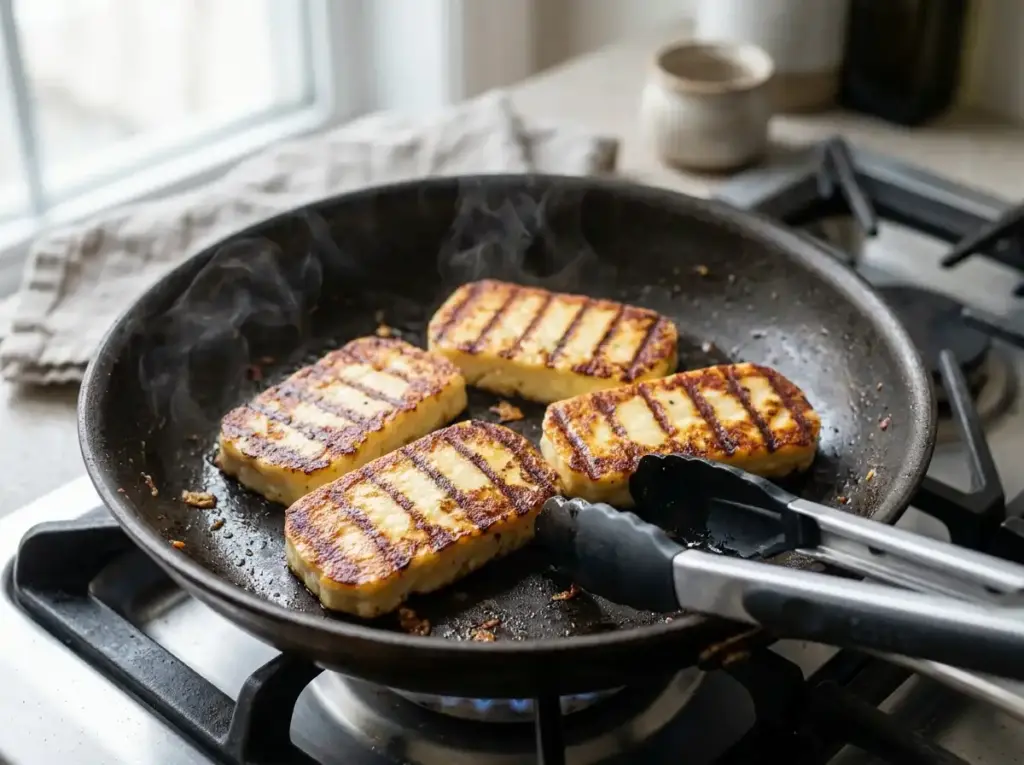
Use a dry pan. Halloumi is roughly a quarter fat by weight, and that fat renders out as it heats. Add oil and you’re frying cheese in a pool of oil — it goes greasy rather than crisp. The pan needs nothing.
Get it properly golden, then stop. Two to three minutes a side over medium-high heat. Longer doesn’t make it crisper; it makes it tough, because the protein network keeps tightening.
Eat it warm. This is the one that catches people out. As halloumi cools, that same firm protein structure becomes rubbery and produces the squeak everyone associates with it. Warm halloumi is soft inside with a crisp shell. The same slice twenty minutes later is a different food.
Which is why this salad is assembled with the cheese hot, and why it doesn’t keep.
A Note on Sodium
1,419 mg per serving, about 62% of the WHO’s 2,300 mg daily limit. That’s the second-highest figure on this site, and it’s a consequence of what halloumi is rather than of any seasoning choice. The recipe contains no added salt.
| Source | Whole recipe (serves 2) | Share |
|---|---|---|
| Halloumi | 1,950 mg | 69% |
| Canned chickpeas | 861 mg | 30% |
| Everything else | 26 mg | 1% |
Halloumi is stored in brine — that’s how it’s preserved, and it can’t be cooked out.
What genuinely helps:
Rinse the chickpeas rather than just draining them. That removes around 40% of their sodium, roughly 172 mg per serving.
Soak the halloumi in cold water for 30 minutes to two hours before cooking, changing the water once. This is a standard technique and it does reduce saltiness noticeably. I can’t give you a figure for it — the amount that leaches out depends on the brand, the thickness of the slices and how long you leave it — so the number on this page assumes you didn’t.
Use 100 g of halloumi instead of 150 g. That takes roughly 325 mg off each serving, but it also drops the protein to about 25 grams, which is right at the floor of what makes this a high protein meal.
This is a good occasional dish rather than a weekly one. If you want a vegetarian salad with a similar protein number at a fraction of the sodium, the edamame and crispy tofu salad sits at 442 mg. The lowest of all fifteen is the shrimp and avocado salad at 226 mg, if you eat seafood.
What You Need
Serves 2.
For the salad
- 5.3 oz halloumi (150 g), about ⅔ of a standard block
- 2 cups canned chickpeas, drained and rinsed (350 g), about 1½ cans
- 1½ cups diced cucumber (200 g), about 1 large
- 2 medium tomatoes, diced (200 g)
- ½ cup thinly sliced red onion (60 g)
- ½ cup chopped mint (30 g)
For the dressing
- 2 tablespoons fresh lemon juice (30 g)
- 2 teaspoons extra-virgin olive oil (10 g)
Notes on the ones that matter:
Slice the halloumi about half an inch thick. Thinner slices dry out before they brown and turn leathery. Thicker ones stay cold in the middle. Half an inch gives you a crisp surface and a soft interior.
Thirty grams of mint is a lot, and it should be. Halloumi and chickpeas are both rich and mild; mint is what stops the bowl feeling heavy. Parsley works but doesn’t do the same job.
Very little olive oil — two teaspoons for the whole recipe. There’s already 37.5 grams of fat coming out of the halloumi. A conventional dressing on top would be too much.
No salt. Not at any stage, not at the table.
How to Make It
- Drain and rinse the chickpeas thoroughly, dry them, and season with black pepper and a squeeze of the lemon.
- Chop the cucumber, tomatoes and red onion, and toss with the chickpeas, mint, lemon juice and olive oil.
- Pat the halloumi dry and slice it about half an inch thick. Surface moisture is what stops it browning.
- Heat a dry nonstick or heavy pan over medium-high. No oil.
- Sear the halloumi 2 to 3 minutes a side, until deeply golden. Leave it alone between turns.
- Lay it over the dressed salad while still hot and serve immediately.
Tips
Dry the halloumi properly before it goes in the pan. It comes out of the packet wet with brine, and wet cheese steams instead of browning. Paper towels, both sides, and give it a minute.
Dress the salad before you cook the cheese, not after. Halloumi is only good for a few minutes off the heat, and you don’t want it waiting while you chop tomatoes.
Don’t crowd the pan. Slices need space or they steam each other. Two batches is better than one crowded one.
A squeeze of lemon over the hot halloumi as it comes out of the pan is worth doing. The acid cuts the fat immediately, and the cheese absorbs it while it’s still hot.
Substitutions
Paneer instead of halloumi. Behaves the same way in the pan and is substantially lower in sodium, though also much milder — it needs more seasoning elsewhere.
Feta, if you don’t want to cook anything. It won’t sear, so you’d crumble it over instead. Lower in protein and the salad drops to around 26 grams per serving.
White beans instead of chickpeas. Creamier, similar nutrition.
Add-ins worth trying: watermelon in summer, which is the classic pairing with halloumi and mint; pomegranate seeds; a pinch of za’atar or sumac over the cheese; or a handful of arugula underneath.
Storage
Same day, and really within the hour.
This is one of two recipes on this site I’d tell you not to make ahead. Halloumi that has been refrigerated after cooking is rubbery, and reheating recovers only part of it.
What you can do is prepare the chickpea and vegetable base up to 3 days ahead — it improves in the lemon — and sear the halloumi fresh, which takes five minutes.
For a vegetarian option genuinely built for the fridge, the lentil and feta herb salad keeps 3 days and gets better overnight.
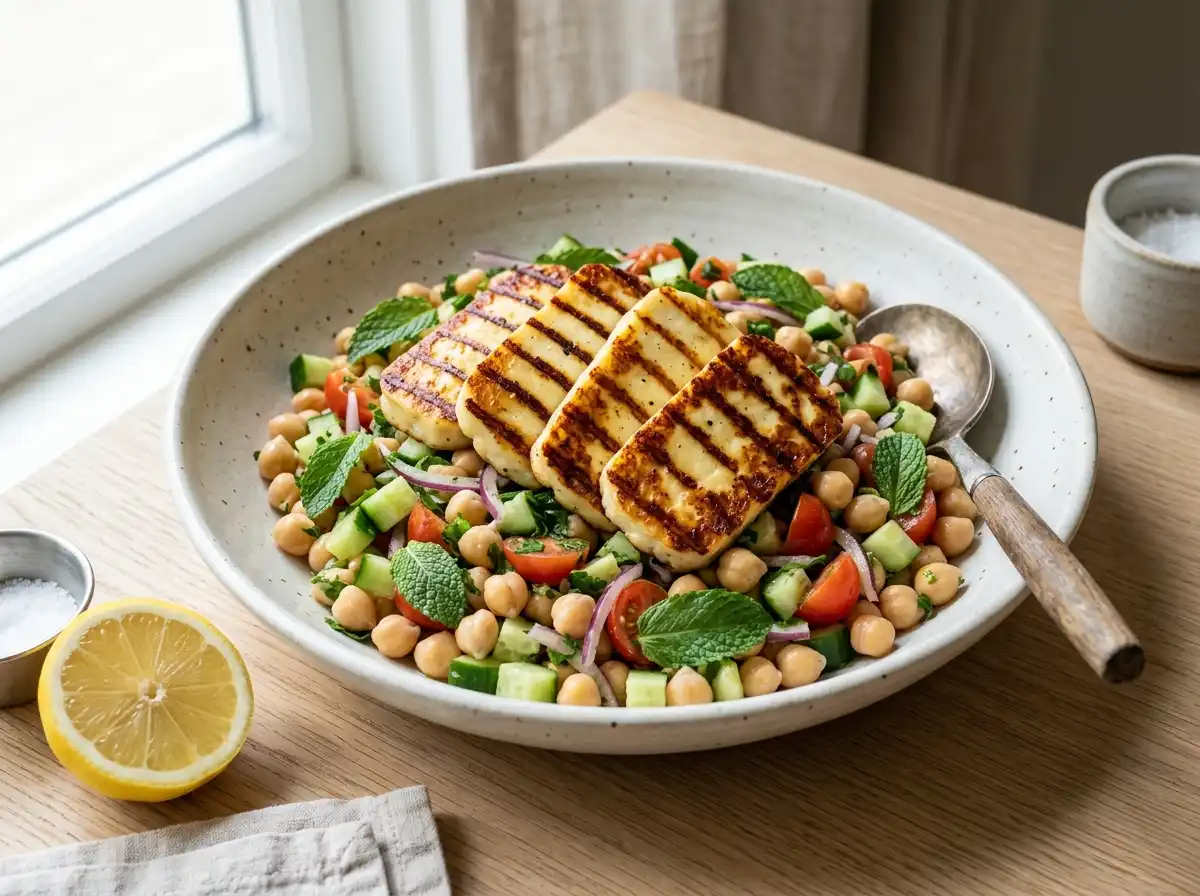

High Protein Halloumi and Chickpea Salad
Ingredients
Method
- Drain and rinse the chickpeas thoroughly, dry them, and season with black pepper and a squeeze of the lemon juice.
- Dice the cucumber and tomatoes, slice the red onion thinly, and toss everything with the chickpeas, mint, remaining lemon juice and olive oil.
- Pat the halloumi completely dry and slice it about half an inch thick.
- Heat a dry nonstick or heavy pan over medium-high heat. Do not add oil — halloumi releases plenty of its own fat.
- Sear the halloumi for 2 to 3 minutes per side, without moving it, until deeply golden.
- Lay the hot halloumi over the dressed salad and serve immediately. Do not add salt at any stage.
Notes
- Halloumi must be eaten warm. As it cools, its protein structure firms up and the cheese turns rubbery and squeaky.
- High in sodium at 1,419 mg per serving, 69% of it from the halloumi, which is stored in brine. Soaking the cheese in cold water for 30 minutes before cooking reduces saltiness.
- Rinsing the chickpeas rather than only draining them removes about 172 mg of sodium per serving.
Nutrition
Per serving (recipe makes 2):
| Calories | 583 |
| Protein | 30 g |
| Carbohydrates | 54 g |
| Fiber | 14 g |
| Fat | 29 g |
| Sodium | 1,419 mg |
These figures are calculated ingredient by ingredient from a USDA-sourced nutrition database and divided by the serving count. They’re calculated values rather than laboratory-tested ones, and they’ll shift with your brands — halloumi varies considerably in salt content between producers, so check the label if the figure matters to you. Chickpeas are a drained weight, calculated without rinsing, and the figures assume the halloumi has not been soaked. Carbohydrates include fiber, following the US convention, so net carbs are about 39 grams per serving.
At 583 calories this is the richest of the vegetarian recipes here, most of it from the halloumi, which is roughly a quarter fat by weight.
Frequently Asked Questions
Why doesn’t halloumi melt?
The curds are heated during production, before the cheese is brined, which permanently sets its protein structure. Reheating it later softens the cheese and browns the surface, but the structure holds — so it keeps its shape in a hot pan where other cheeses collapse.
Do you need oil to cook halloumi?
No, and you shouldn’t use any. Halloumi is roughly a quarter fat by weight and renders enough of its own to brown in a dry pan. Added oil makes it greasy rather than crisp.
Why is my halloumi squeaky and rubbery?
It’s gone cold. The same protein structure that stops halloumi melting makes it firm and squeaky once it cools. Warm from the pan it’s soft inside with a crisp surface; twenty minutes later it’s a different texture entirely. Sear it last and serve it immediately.
How do you make halloumi less salty?
Soak it in cold water for 30 minutes to two hours before cooking, changing the water once. It genuinely reduces the saltiness, though how much depends on the brand and how thickly you’ve sliced it. The nutrition figures on this page assume you haven’t soaked it.
How much protein is in halloumi?
About 21 grams per 100 g, which is unusually high for a cheese and comparable to cooked chicken thigh. In this salad, 75 g per serving supplies about 16 of the 30 grams of protein.
More High Protein Salads
This is one of fifteen recipes in the high protein salad collection, grouped by no-cook, low carb, vegetarian and meal prep, with protein and calories compared across all fifteen.
For a vegetarian salad with more fiber and less sodium, the lentil and feta herb salad carries 34 grams of protein and 19 grams of fiber.
Made this? Leave a rating and tell me how it went in the comments — especially if you changed something that worked.
The crispy halloumi on top of the chickpeas was the highlight for me. I followed the tip about not adding oil to the pan and it browned nicely. I’d definitely make this again.